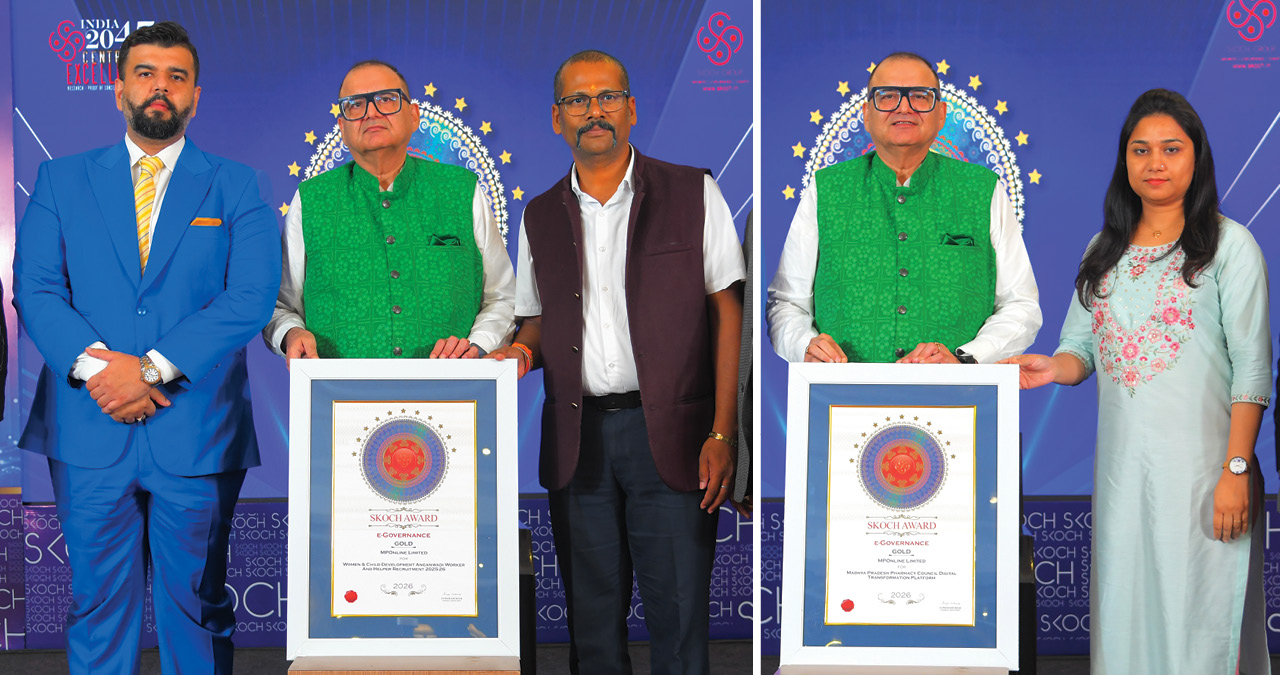
For a woman in a remote Madhya Pradesh village seeking work as an Anganwadi helper or for a pharmacist trying to renew a registration, dealing with the government once meant paperwork, travel and uncertainty. Two initiatives by MPOnline Limited show how redesigning the process, not just putting forms online, can change that experience.
The more ambitious project is the Chayan Portal, developed in collaboration with the Department of Women & Child Development to recruit Anganwadi Workers and Helpers. Earlier, recruitment across 52 districts relied on offline applications and manual processing. Rural women faced distance and paperwork barriers, while administrators dealt with thousands of applications, delayed vacancies and limited auditability.
Chayan replaced this with what the project describes as India’s first fully digital Anganwadi recruitment system. 19,504 vacancies were processed through an end-to-end workflow, covering registration, eligibility validation, merit generation and grievance handling. Selection is based on academic qualifications, eliminating subjective interviews and manual intervention.
Importantly, digitisation did not become a barrier for rural women. MPOnline’s network of over 53,000 kiosks provided assisted access across Madhya Pradesh. The system moved from project initiation to statewide rollout in about five months, covering development, testing and training across all 52 districts.
Here, the problem was regulatory integrity, not recruitment. Registration and renewal were paper-based; educational documents required manual verification; duplicate registrations were possible; even deceased pharmacists remained active in the records.
The redesigned platform integrates Samagra for identity authentication and deduplication and DigiLocker for document verification and certificate issuance. Five digital modules cover fresh registration, renewal, correction of registration, a publicly searchable E-Register and online slot booking. The nomination reports 100% online registration and renewal, elimination of duplicate and fraudulent registrations and an ecosystem serving around 100,000 external beneficiaries.
Together, the projects illustrate a useful progression in e-governance. Technology is doing more than replacing paper.
"American roads are good not because America..
State Rankings Highlights -: Odisha scaled to number..
Step 1: Call for Project Submission Call for..
In the run-up to the elections, the most..

Inclusion is the first magazine dedicated to exploring issues at the intersection of development agendas and digital, financial and social inclusion. The magazine makes complex policy analyses accessible for a diverse audience of policymakers, administrators, civil society and academicians. Grassroots-focused, outcome-oriented analysis is the cornerstone of the work done at Inclusion.