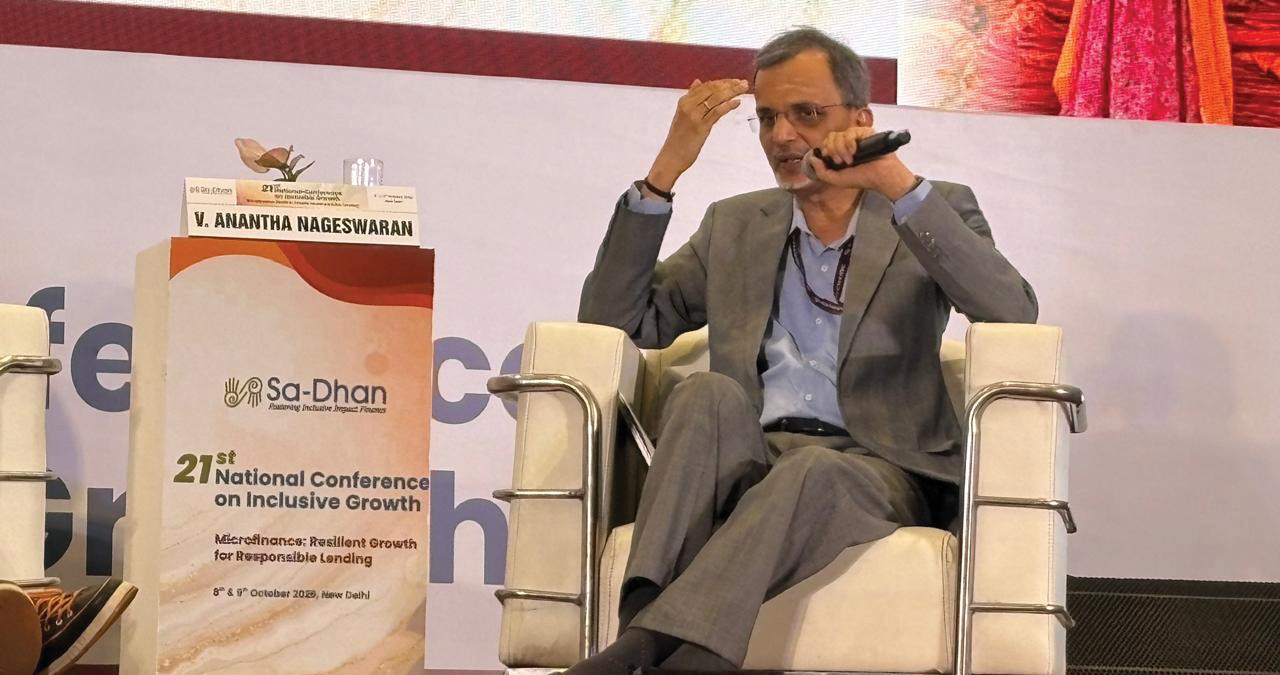
Chief Economic Adviser V Anantha Nageswaran called for state-specific development strategies, greater investment in vocational skills, timely MSME payments and stronger local governance. He also underlined the importance of microfinance, entrepreneurship and physical and mental well-being in building an inclusive economy.
India must rethink its inherited capital-intensive development model and place employment, entrepreneurship and human capital at the centre of its growth strategy, V Anantha Nageswaran, Chief Economic Adviser to the Government of India, said at the 21st National Conference on Inclusive Growth, organised by Sa-Dhan in New Delhi.
India’s labour-abundant economy requires a development approach that recognises employment as its greatest imperative. The capital-intensive model inherited from advanced economies, where technology replaced scarce labour, is not necessarily suited to India’s circumstances, he argued.
“Different states have to be allowed to pursue different paths,” Nageswaran said, advocating differentiated development strategies based on regional strengths.
Advanced states could pursue capital-intensive manufacturing, less-developed states could concentrate on labour-intensive industries, while agriculturally endowed regions could build capabilities in farming and agro-processing. India’s federal structure, with 28 states, offered considerable scope for such experimentation.
Nageswaran identified regulatory compliance and delayed payments as major constraints on MSME growth.
Ease of doing business mattered far more to smaller enterprises than to large corporations because compliance consumed their limited financial and managerial resources. Deregulation, simplification and consolidation of requirements, particularly at the local level, could release resources for productive activity.
He acknowledged that delayed payments remained a persistent problem, particularly when smaller suppliers dealt with powerful buyers.
Government can prepare the ground, but it cannot walk at all, he remarked, emphasising that businesses must also accept responsibility.
He pointed to the expansion of receivables discounting through TReDS, from approximately ₹3,000 crore to nearly ₹3.5 lakh crore, while acknowledging considerable scope for further growth.
Government departments and public-sector enterprises, he said, must set an example by paying suppliers promptly. He also called for greater flexibility in banking norms governing stressed MSME accounts, recognising that working-capital cycles differed across industries.
Artificial intelligence could force India to reconsider its longstanding preference for university degrees over vocational qualifications.
The answer lies not in all of us pursuing a computer science degree, but multiple disciplines, Nageswaran observed.
Skills such as carpentry, welding, electrical work and plumbing deserved greater recognition. Vocational qualifications needed improved social standing, particularly when skilled tradespeople could earn more than university graduates.
AI, he suggested, might ultimately prove beneficial by encouraging young people towards occupations less vulnerable to automation.
Nageswaran placed entrepreneurship alongside employment as a fundamental development priority.
“Entrepreneurship is a very important answer which will lead to job creation,” he said, describing the removal of obstacles to enterprise formation as both an economic and policy priority.
Microfinance could contribute substantially by enabling income generation, cultivating savings habits and supporting entrepreneurship rather than concentrating exclusively on credit delivery.
He also stressed the importance of strengthening local governments through adequate finances, administrative capacity, better property-tax collection and reasonable user charges.
Efficient expenditure mattered as much as higher allocations. Eliminating undeserving beneficiaries, duplication and leakages could improve outcomes without necessarily requiring additional resources.
Turning to human development, Nageswaran warned that unhealthy lifestyles threatened productivity.
Physical and mental well-being, he argued, were inseparable from economic progress. Excessive screen time, unhealthy diets and inadequate sleep required changes in individual behaviour alongside public interventions.
He advocated greater access to counselling in educational institutions, describing human interaction as indispensable despite advances in AI.
Ultimately, his message was that inclusive growth required more than investment and technology. It demanded productive employment, entrepreneurial opportunity, practical skills, healthier citizens and governments capable of translating resources into meaningful improvements in people’s lives.
"American roads are good not because America..
State Rankings Highlights -: Odisha scaled to number..
Step 1: Call for Project Submission Call for..
In the run-up to the elections, the most..

Inclusion is the first magazine dedicated to exploring issues at the intersection of development agendas and digital, financial and social inclusion. The magazine makes complex policy analyses accessible for a diverse audience of policymakers, administrators, civil society and academicians. Grassroots-focused, outcome-oriented analysis is the cornerstone of the work done at Inclusion.