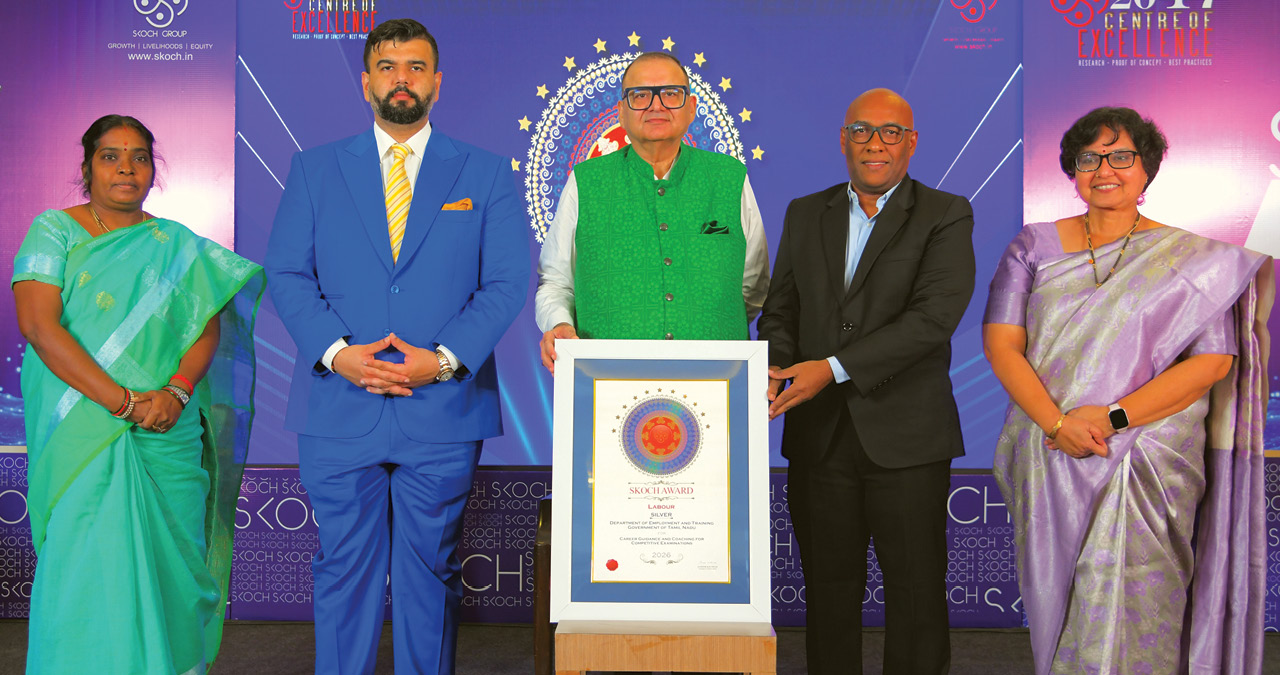
For a young person in rural Tamil Nadu aspiring to a government job, competitive examinations present a peculiar inequality: talent is widely distributed, but good coaching, books, mentoring and timely information often are not. Tamil Nadu’s Department of Employment and Training has sought to narrow this gap by turning career guidance into a statewide public service.
At its core is a hybrid model that avoids choosing between physical and digital delivery. Study Circles, operating through District Employment and Career Guidance Centres, offer free coaching, expert faculty, study material, mock examinations and access to libraries. Each district library has more than 3,000 competitive-examination books, supported by journals and digital facilities.
The model has steadily expanded. Study Circles date back to 1999. Coaching centres in colleges affiliated with 10 universities followed in 2017. The Virtual Learning Portal arrived in 2019. Kalvi TV then brought competitive-examination coaching directly into homes.
The numbers show the scale of this transition. Between 2021 and 2026, 18,476 career-guidance programmes reached more than 17 lakh young people, demonstrating the programme’s reach. Study Circles trained 97,466 aspirants and 9,161 cleared competitive examinations, showing how the training translated into results. Digital delivery has widened the circle further.
The Virtual Learning Portal integrates exam notifications, learning resources and online preparation. The presentation reports 5.97 lakh registered candidates, 1.21 crore portal visits and more than 15 lakh course enrolments, indicating sustained use. Its learning architecture now includes bilingual current affairs, timed online tests, visual mind maps, model answers and editorial analysis.
These resources are designed not only to inform candidates but also to improve how they prepare. Achievement is therefore institutional. Employment offices are being repositioned from registration points to career-development hubs, combining counselling, psychometric assessment, coaching and technology to reshape how support reaches aspirants.
Tamil Nadu’s experience makes a simple proposition compelling: when the aspirant cannot reach opportunity, government can bring opportunity closer.
"American roads are good not because America..
State Rankings Highlights -: Odisha scaled to number..
Step 1: Call for Project Submission Call for..
In the run-up to the elections, the most..

Inclusion is the first magazine dedicated to exploring issues at the intersection of development agendas and digital, financial and social inclusion. The magazine makes complex policy analyses accessible for a diverse audience of policymakers, administrators, civil society and academicians. Grassroots-focused, outcome-oriented analysis is the cornerstone of the work done at Inclusion.