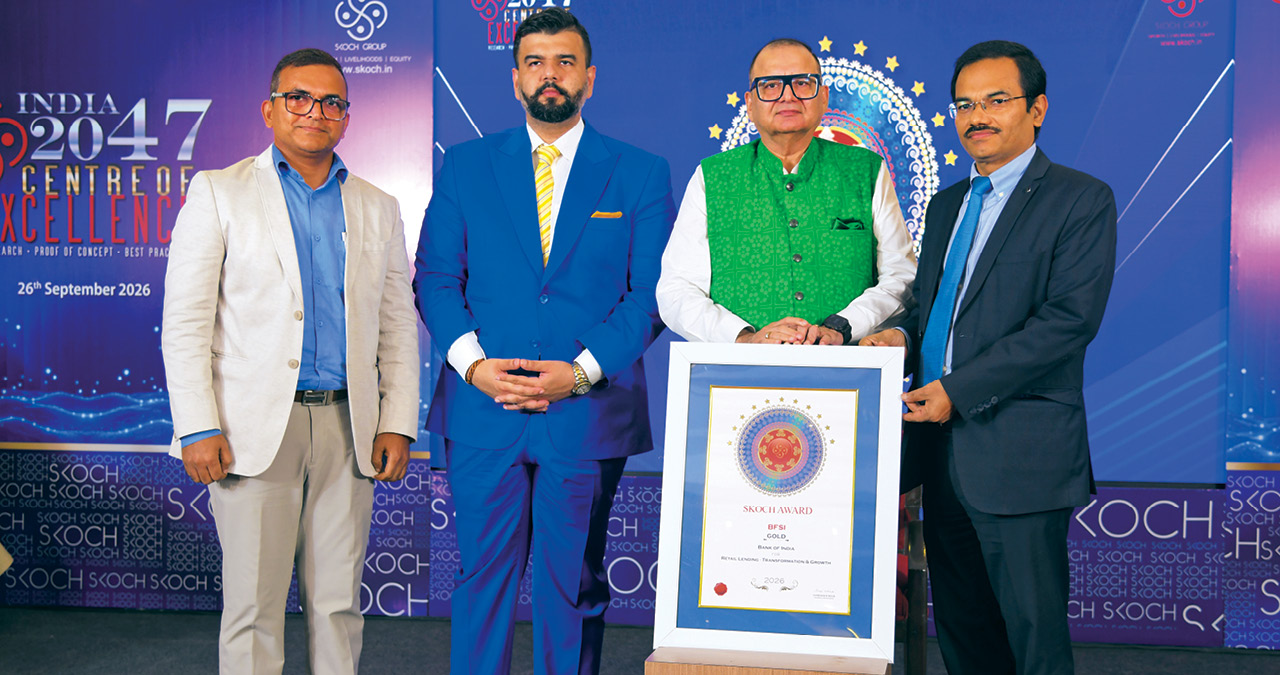
(L to R) Anand Bhat, Assistant General Manager, Bank of India; Rohan Kochhar, SKOCH Development Foundation and Founder, SKOCH Law Offices; Sameer Kochhar, Chairman, SKOCH Group; Anup Sharma, Zonal Head - Delhi, Bank of India
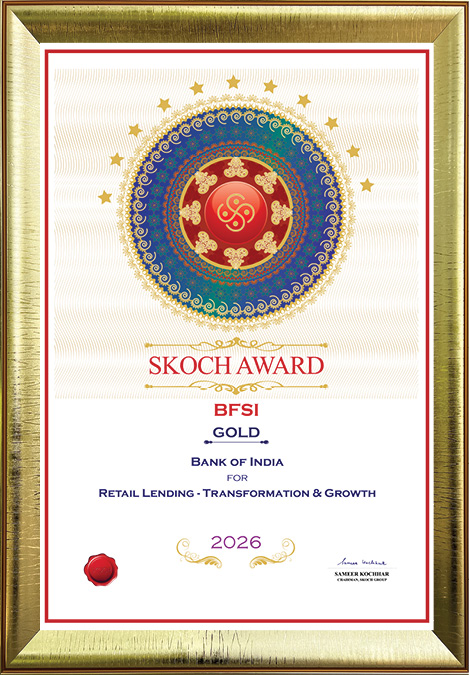
At first glance, the headline number tells a straightforward story of growth: retail advances reached ₹1,63,408 crore by 31 March 2026, up 21.46% year-on-year and ahead of the industry growth of 16.24%. But beneath that number lies a more significant transformation. The retail lending programme sought to change not only how much was lent, but also how customers were acquired, loans were processed, risks were assessed and relationships were retained.
During the year, 2.84 lakh new accounts worth ₹51,993 crore were sanctioned across housing, vehicle, education, loan against property (LAP) and personal loans. Total sanctions reached ₹69,112 crore, while disbursements stood at ₹66,620 crore. Schematic retail outstanding alone reached ₹1,38,606 crore, up 18.6%. The programme reports 17,45,221 external beneficiaries.
What makes the Bank of India retail lending story notable is that this expansion came alongside an improvement in portfolio quality.
The transformation began with five familiar banking challenges: expensive customer acquisition, customer churn, asset quality, product relevance and cumbersome manual processes. Traditional acquisition was costly and slow; manual workflows caused delays and errors; outdated products risked losing customers to competitors.
The response was to treat retail lending as an interconnected system of people, processes and products. Product development teams and a marketing committee studied customer preferences and market needs. Variants were developed for home loans, top-up loans, vehicle loans, education loans, LAP and personal loans. Monthly retail disbursement drives, vehicle-loan campaigns and education campaigns during admission periods were conducted. Marketing covered digital advertising, social media and direct channels, with performance and customer response feeding back into product refinement.
Omnichannel marketing was accompanied by digital onboarding for both existing and new customers. Credit-scoring models were reviewed, products were evaluated against customer requirements and retention strategies focused on quality customers. During the year, digital journeys were introduced for personal, vehicle and home loans across the portfolio.
The results were broad rather than concentrated in a single product.
Home loans rose from ₹68,397 crore to ₹79,970 crore, an increase of ₹11,574 crore (16.9%). Vehicle loans climbed from ₹20,903 crore to ₹24,928 crore, an increase of ₹4,025 crore (19.3%). Education loans increased from ₹4,008 crore to ₹4,765 crore, a rise of ₹757 crore (18.9%). Personal loans moved from ₹12,680 crore to ₹13,228 crore, adding ₹549 crore (4.3%).
LAP was particularly brisk, expanding from ₹10,860 crore to ₹15,713 crore, an increase of ₹4,854 crore or 44.7%. Gold loans added ₹5,175 crore, recording 238% growth.
The comparative figures provide context. In FY2025-26, industry growth stood at 11.48% for home loans, 13.38% for education, 18.61% for vehicles and 12.98% for personal loans, with overall growth of 16.24%. The corresponding retail portfolios grew by 16.92%, 18.89%, 19.26%, 4.33% and 21.46%, respectively.
Market share consequently reached 2.38% in home loans, 3.06% in education loans, 3.37% in vehicle loans, 0.76% in personal loans and 2.35% overall. Overall market share rose from 2.09% to 2.25% and then to 2.35% over FY2023-24 to FY2025-26.
Rapid lending growth can be dangerous if underwriting weakens. Here, the credit profile improved instead. In FY2025-26, 56% of sanctioned retail amounts were associated with borrowers having CIBIL scores of 800 or above, compared with 48% the previous year, an 8-percentage-point improvement. The 700-799 group declined from 37% to 31%, while the 0/-1 score category fell from 10% to 8%. Distribution differed by product: 66% of home-loan sanctions, 50% of vehicle loans and 34% of personal loans were in the 800-plus category.
More striking was the reduction in stress. Total retail NPA stood at ₹2,709 crore (1.7%), while SMA outstanding was ₹11,471 crore (7.1%). In March 2024, those ratios were 2.3% and 17.8%, respectively. Over two years, SMA outstanding fell by ₹7,973 crore, from ₹19,444 crore to ₹11,471 crore. The NPA ratio improved by 60 basis points, while the SMA ratio improved by 1,070 basis points.
"American roads are good not because America..
State Rankings Highlights -: Odisha scaled to number..
Step 1: Call for Project Submission Call for..
In the run-up to the elections, the most..

Inclusion is the first magazine dedicated to exploring issues at the intersection of development agendas and digital, financial and social inclusion. The magazine makes complex policy analyses accessible for a diverse audience of policymakers, administrators, civil society and academicians. Grassroots-focused, outcome-oriented analysis is the cornerstone of the work done at Inclusion.