There was a time when applying to college in Odisha meant starting a journey. A student had to travel to an institution to collect its prospectus and application form, fill them out, submit them and then repeat the process elsewhere. Applicants typically applied to three or four colleges or streams. Each institution printed its own prospectus and different streams required different application forms. There was no uniform timeline for selection or notification.
Then came the waiting.
Information on previous years’ cut-offs was not readily available. Results could arrive by post. Multiple applications led to repeated document submissions, increased paperwork for institutions, and additional processing. For families, the application fee was only part of the cost; travel, accommodation and food added expenses that were seldom counted. Because selection lists were prepared manually, questions about transparency could arise.
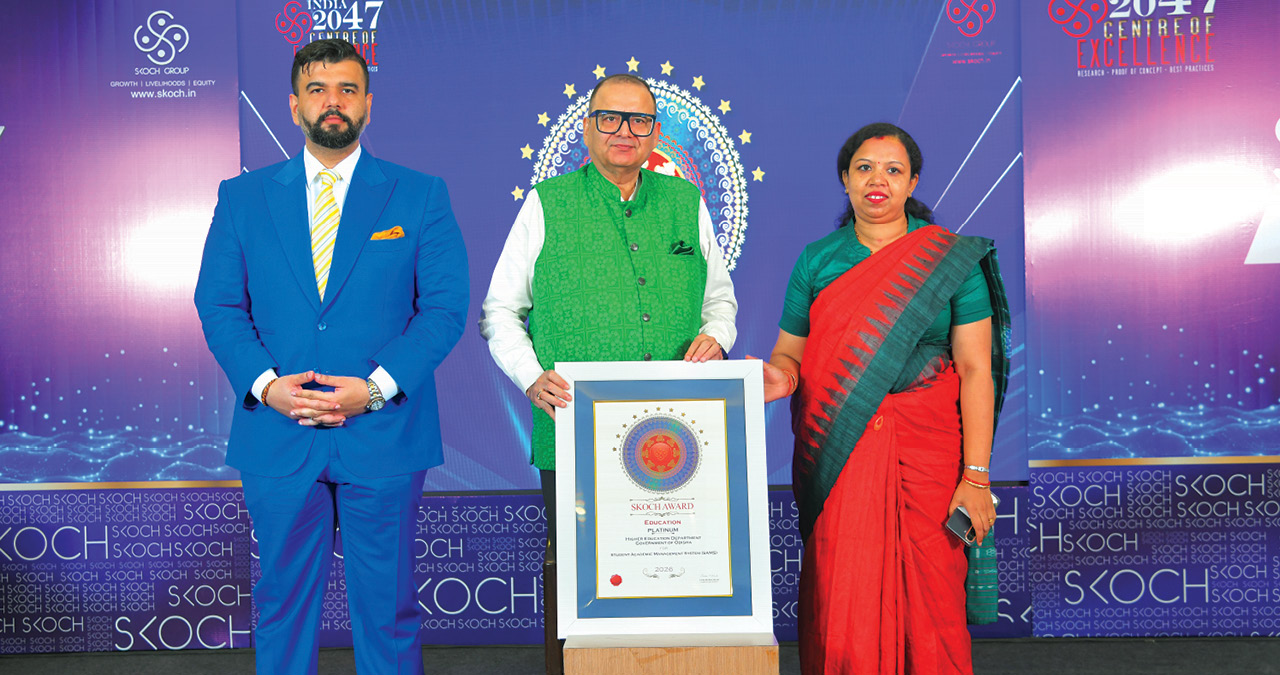
Odisha’s answer was simple: why should a student submit multiple applications when the government could create a single, common application and manage the complexity behind it? That idea became the Student Academic Management System or SAMS, an initiative of the Government of Odisha’s Higher Education Department.
What began in 2009-10 has evolved into a statewide academic management system covering over 4,921 institutions and simplifying admissions for around 1.25 million applicants. In 2025-26 alone, the system collected more than ₹250 crore in application and admission fees. Most importantly, SAMS marks Odisha’s shift from “One Applicant-Many Applications” to “One Applicant-One Common Application.”
The scale did not come overnight. The SAMS journey began in 2009 with 60 Higher Secondary Schools across 30 districts. It expanded to 169 Higher Secondary Schools and 53 degree institutions and later to additional colleges. By 2014, coverage reached 1,970 Higher Secondary Schools and 840 degree institutions. In 2015, the system was piloted across 49 government ITIs.
The expansion went beyond conventional higher secondary and degree education. By 2018-19, the ecosystem included polytechnic institutions, teacher education, physical education colleges, ITIs, diploma programmes and other specialised courses. Postgraduate programmes followed. Utkal Sangeet Mahavidyalaya, law courses, integrated B.Ed., M.Ed. programmes, performing arts and other specialised programmes were progressively added. More recently, SAMS has accommodated NEP 2020, apprenticeship-embedded degree programmes, and the Integrated Teacher Education Programme. The intervention now reports a total institutional footprint of 4,921.
That growth matters because Odisha was not creating separate digital islands for every category of education. The platform increasingly became common infrastructure across departments and courses.
Its coverage today spans the Higher Education; School and Mass Education; Skill Development and Technical Education; Sports and Youth Services; and, Odia Language, Literature and Culture departments. Degree and postgraduate programmes sit alongside ITIs and diplomas, teacher education, physical education, law, performing arts and higher secondary education.
The most visible transformation is still at the front end, where the application experience changed most directly.
Under the old arrangement, a student applying to several colleges effectively repeated the same information multiple times. Each additional application created another transaction for the student and increased the institution’s administrative workload.
“What began as an admissions reform has evolved into an integrated academic management ecosystem that connects institutions’ payment systems, academic records and government databases while supporting emerging educational programmes and changing student requirements”
A unified portal and a common prospectus give students a single window into the admission system. Instead of navigating multiple institutional procedures separately, applicants can make choices through a single process. The number of visits to the destination college has fallen from three to one. As online access has expanded, especially with improved Internet connectivity in remote areas, the admissions process has become more accessible.
There is another, less obvious benefit: information changes the quality of choice.
The common prospectus enables applicants to make decisions with better visibility into institutions and previous admission patterns. Nearly 70% of applicants secure admission to their first-choice colleges.
That is an important outcome because digitisation is often evaluated on processing speed or administrative savings. In education, however, the central point is better-informed choice, which is SAMS’s core contribution. A system that helps students understand their options before expressing preferences reduces uncertainty and the likelihood that choices are made simply because information was hard to obtain. At that scale, even a small amount of friction imposed on each applicant multiplies into substantial social and administrative costs.
SAMS attempts to remove that friction at source.
Behind the seemingly simple experience of filling out a common application lies a much more complex administrative engine.
Admissions are not simply about ranking examination marks. Eligibility must be verified. Marks from different boards or universities may require conversion or normalisation. Reservation policies must be applied. Additional weightage may be given. Ties must be resolved. Seats are finally allotted based on merit, reservation and the applicant’s preferences.
SAMS brings these rules into a centralised selection process. The platform validates applicant information, documents and subject-wise eligibility criteria. It automatically applies state reservation provisions for categories such as SC, ST, SEBC, ESM and PwD. Marks from different boards and universities are converted into a standardised format, and applicable weightage for NCC, NSS, sports, Scouts and Guides is added.
It then generates course-wise, college-wise and category-wise merit lists. When candidates are tied, sequential tie-breaking rules, such as subject marks, age and alphabetical order, are applied. Seats are finally allocated based on merit, reservation rules and preferences. This is where the central governance significance of SAMS becomes clearer.
A transparent admissions system is not created merely by publishing results online. Transparency begins much earlier, with consistent rules and reduced scope for discretionary variation in their application.
The pre-SAMS system had raised concerns about manually prepared selection lists. SAMS replaces much of that dispersed manual decision-making with a common, rule-based process, thereby reducing variation at the point of decision-making. The result is a standardised admissions process at a scale that would be difficult to achieve if thousands of institutions processed admissions independently.
The student sees an application. The system sees a chain of interconnected transactions.
The SAMS process begins with the online application and the generation of applicant and college copies. It moves through document verification, centralised selection and the publication of merit lists. It continues with approval or rejection, admission updates and error reporting. It also supports functions such as roll numbers, money receipts, preparation and validation of student records, issuing registration numbers, form filling, MIS reporting and generating admit cards.
This is supported by integrations with result databases, including payment gateways; DigiLocker; e-District for caste certificates; NCVT; and, communication channels, including SMS, email and WhatsApp.
That interconnectedness is central to a system’s maturity and helps explain the shift from separate tasks to a unified process. A digital admission portal that requires students to manually transfer information between government databases merely shifts paperwork from the counter to the citizen. Integration changes this. It enables different parts of academic administration to communicate and reduces the need for applicants to act as couriers between government systems. It also creates unified data.
“SAMS demonstrates how sustained digital reform can reshape public education administration. By accommodating new programmes, online transfers, automated refunds and technology-enabled verification, Odisha is building a more responsive, accessible and student-centred education system”
For administrators, the admission process is no longer scattered across thousands of prospectuses, forms, registers and local lists. For institutions, it reduces redundant processing. For students, it creates a more coherent journey from application through admission and academic administration.
The surrounding education system has changed and the platform has had to adapt. New enhancements include an online refund module integrated with Axis Bank and supported by a Maker-Checker approval workflow, making refunds faster, more automated and more transparent. An online transfer module now handles applications, verification, eligibility checks, seat validation and approvals digitally.
More fundamentally, the platform has begun accommodating changes associated with the National Education Policy 2020. The Apprenticeship Embedded Degree Programme, meanwhile, integrates mandatory apprenticeships into degree and diploma programmes, combining classroom education with industry training. SAMS therefore has to support not merely a new admission category but an evolving relationship between academic learning and employability.
From the 2026-27 academic session, the four-year Integrated Teacher Education Programme will be introduced in selected higher education institutions. Admissions will be conducted through SAMS using NCET percentile scores published by NTA, ensuring a merit-based, common process.
And here, artificial intelligence is beginning to enter the story.
The SAMS ITEP portal uses AI-based scorecard verification to automate the process, aiming to improve speed, accuracy and transparency. Other additions include an online module for higher education institutions to submit, verify and monitor Utilisation Certificates, and an objection-invitation module to manage challenges and suggestions regarding answer keys for B.Ed., M.Ed. and postgraduate entrance exams.
The direction is important. SAMS is moving from digitising a transaction towards supporting a broader academic lifecycle.
The strongest public digital systems often make their achievements seem ordinary. A student filling out one form instead of four does not sound like radical governance reform. Neither does avoiding two trips to a college.
But multiply those changes across 1.25 million applicants and their significance changes.
Before SAMS, repeated applications meant repeated fees, paper, travel and processing. Institutions bore the workforce cost of handling multiple forms from the same applicant. Students and families faced visible and hidden expenses. Selection schedules were less predictable and information asymmetry made decision-making harder.
It reduces duplication for citizens. It reduces redundant processing for institutions. It creates a common information base. It standardises selection. It allows the government to manage admissions as a system rather than as thousands of separate institutional events.
That is why the ₹250-plus crore processed through SAMS in 2025-26 should be read as more than a payment statistic.
SAMS is ultimately a story about how a relatively narrow administrative problem can become the catalyst for much larger institutional reform. The original problem was easy to understand: students were travelling from college to college, buying prospectuses, filling out multiple forms, and waiting for independently managed selection processes.
The first answer was also easy to understand: create a common application.
But once admissions became common, selection rules could be standardised. Once selection became centralised, information could be unified. Once data was unified, institutions, courses, payments, certificates, academic records and communication systems could be connected. Once that infrastructure existed, newer reforms, from online transfers and refunds to NEP-related programmes and AI-assisted verification, could be built on top of it.
"American roads are good not because America..
State Rankings Highlights -: Odisha scaled to number..
Step 1: Call for Project Submission Call for..
In the run-up to the elections, the most..

Inclusion is the first magazine dedicated to exploring issues at the intersection of development agendas and digital, financial and social inclusion. The magazine makes complex policy analyses accessible for a diverse audience of policymakers, administrators, civil society and academicians. Grassroots-focused, outcome-oriented analysis is the cornerstone of the work done at Inclusion.