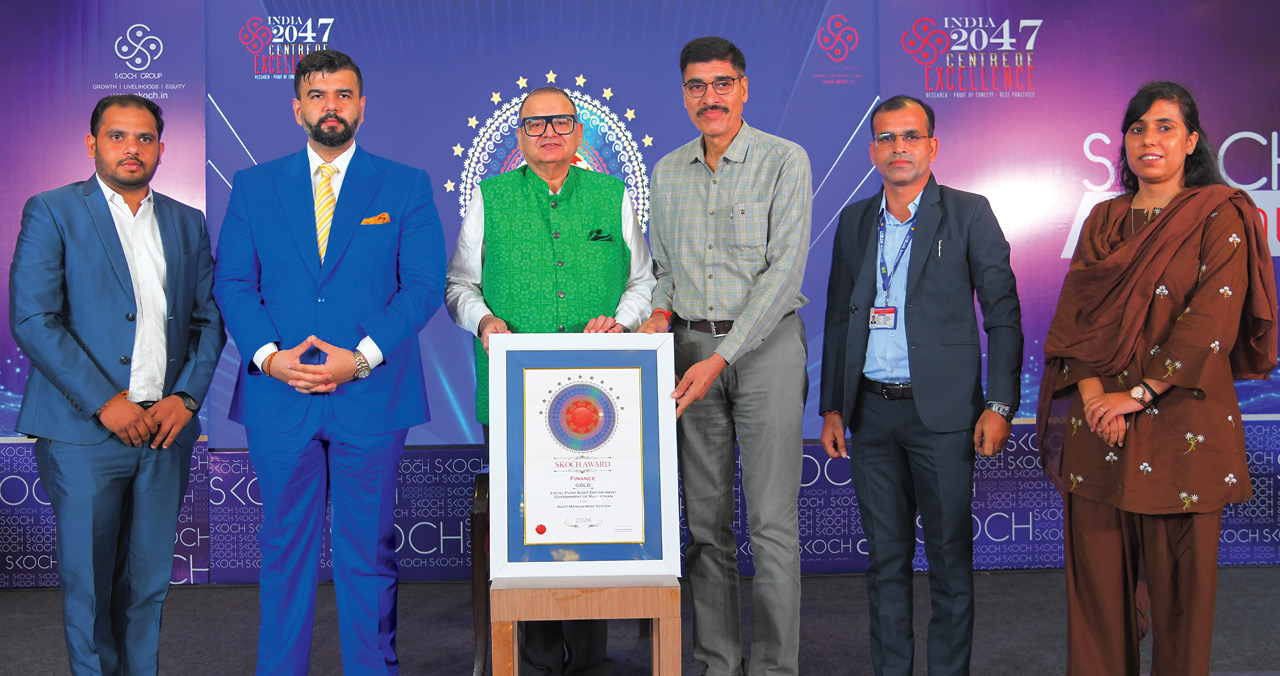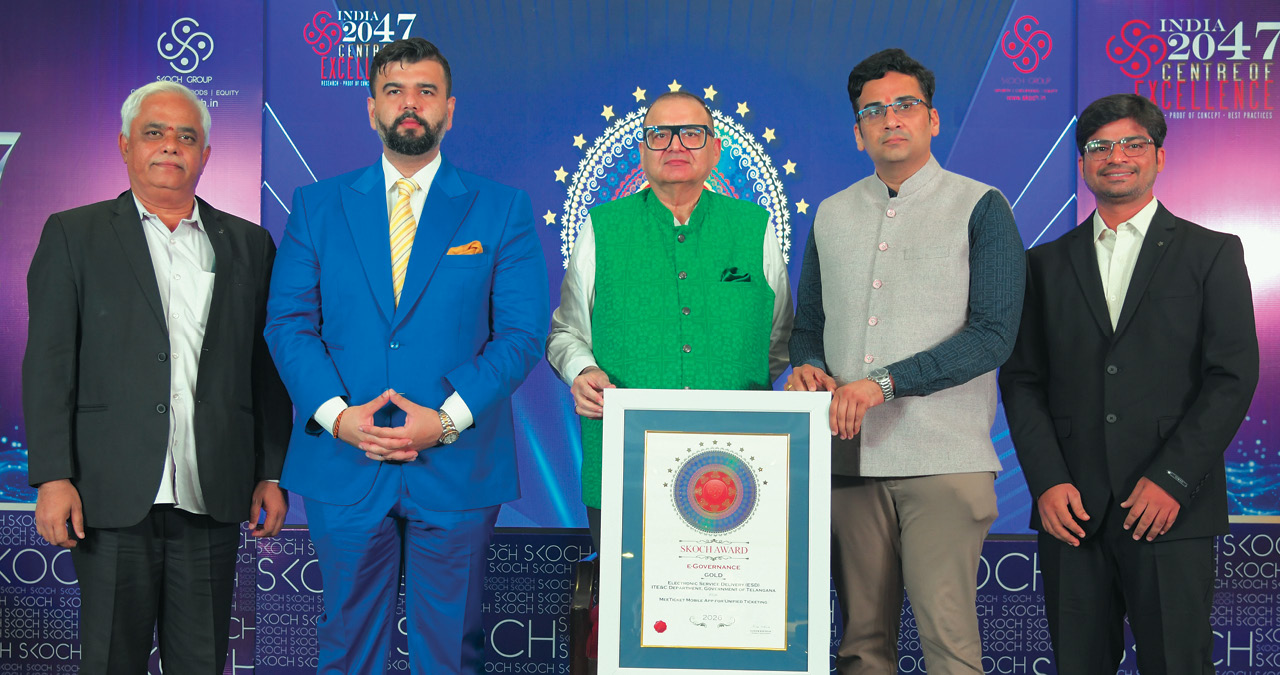
(L to R) T V Raja Rao, ITE&C Department, Government of Telangana; Rohan Kochhar, SKOCH Development Foundation and Founder, SKOCH Law Offices; Sameer Kochhar, Chairman, SKOCH Group; T Ravi Kiran, Commissioner - ESD (MeeSeva), ITE&C Department, Government of Telangana; Umesh B, ITE&C Department, Government of Telangana
For a citizen planning a day out in Telangana, the digital journey could once be surprisingly complicated. A metro ride might require one interface, entry to a tourist attraction another, a boating ticket a separate transaction and the last mile yet another arrangement. Behind the scenes, the government faced a similar problem of fragmentation: departments generated enormous amounts of data, but much of it remained difficult to integrate and use.
Telangana’s ITE&C Department is tackling both problems from opposite ends to build shared digital infrastructure. MEETICKET aims to simplify what the citizen sees by bringing tickets, payments and eventually different modes of mobility into a single interface. TGDeX, the Telangana Data Exchange, is working deeper within the digital architecture, bringing together government datasets, computing infrastructure, AI models and solution builders.
One focuses on making everyday transactions easier. The other, on making government data usable.
Launched on 9 January 2025, MEETICKET emerged from a straightforward problem. Transport, tourism and event ticketing operated in silos. Citizens navigated multiple applications, payment gateways and manual processes. There was no integrated first-mile-to-last-mile journey and reliance on cash and physical tickets created inconvenience and revenue leakage.
The answer was summed up in a simple ambition: “One App. Every Ticket. Every Citizen of Telangana.”
MEETICKET provides a mobile and web interface with QR-based cashless ticketing, UPI payments and real-time reconciliation. On the government side, centralised dashboards provide real-time information on bookings, visitors and revenue.
The breadth of services is what makes the model interesting. The platform has brought together parks, temples, forts, museums, boating, nature camps, tourist destinations and Hyderabad Metro. Since launch, MEETICKET reports more than 2.57 lakh downloads and 7.07 lakh tickets booked, with transaction value exceeding ₹5 crore.
The scale is diverse. The platform lists 137 park and nature locations, 16 temple and endowment locations, 11 forts and museums, 50 boating locations, 5 nature camps, 3 waterfalls and 52 tourist places, along with community facilities and transport services. This is not simply digitisation of a ticket counter. It is an attempt to remove the counter as the organising principle of service delivery and build the infrastructure underneath it.
Forest, Tourism, HMDA, Endowments, GHMC and Metro did not start as a single ticketing organisation. Their systems, workflows and requirements differed. The implementation, therefore, began with stakeholder consultations, followed by the development of a scalable cloud architecture, QR ticketing and UPI integration. Services were then onboarded in phases, with digital workflows and training.
The technical challenges were equally practical: different systems had to communicate via a unified API layer; peak traffic had to be handled through cloud-native auto-scaling; payments required encrypted UPI and automated reconciliation; and, access had to remain mobile-first. The ambition now extends beyond tickets. The roadmap envisages TGRTC bus ticketing, bike, auto and taxi services, EV mobility and parking.
MEETICKET, in other words, is evolving from a ticketing application into a mobility and access layer.
TGDeX addresses a less-visible but equally consequential form of fragmentation.
Government departments possess large volumes of information, but data distributed across systems is difficult to combine. Completeness and usability vary, making evidence-based planning harder. Organisations may also lack the computing resources and tools required to experiment with the information they already possess.
TGDeX was conceived as public infrastructure to make AI in governance easier, cheaper and more inclusive. Rather than creating another standalone database, it combines four building blocks: Data Banks, AI Models, Use Cases and a Sandbox IDE.
The numbers reveal how substantial the underlying data asset has become. The platform hosts more than 500 datasets. ITE&C accounts for 138, Agriculture and Cooperation for 81, Planning for 52, Health for 39 and Energy for 32. Other datasets cover rural development, education, urban services, transport, tourism, irrigation, food distribution, nutrition and the environment.
The challenge attracted 420-plus applications from more than 240 startups, including around 100 applicants from Telangana. More than 70 evaluators from industry and academia participated.
The use cases were firmly grounded in public problems: AI-powered medical imaging for lung conditions, prediction of high-risk pregnancies, an MSME scheme guidance chatbot, optimisation of public transport utilisation, interactive vocabulary learning for classrooms and automated document verification for property registration.
TGDeX was designed around secure, consent-driven data sharing. Its implementation included work on privacy, transparency, accountability and compliance with the DPDP Act 2023. The technology stack includes data-ingestion pipelines, model management, APIs, secure IDE and notebook environments.
MEETICKET and TGDeX operate in very different spaces, yet both point to the same shift in government design. MEETICKET does so through a unified interface, APIs, payments and QR code validation. TGDeX does it through data banks, AI models, computing power, common governance and a sandbox in which solutions can be built and tested.
"American roads are good not because America..
State Rankings Highlights -: Odisha scaled to number..
Step 1: Call for Project Submission Call for..
In the run-up to the elections, the most..

Inclusion is the first magazine dedicated to exploring issues at the intersection of development agendas and digital, financial and social inclusion. The magazine makes complex policy analyses accessible for a diverse audience of policymakers, administrators, civil society and academicians. Grassroots-focused, outcome-oriented analysis is the cornerstone of the work done at Inclusion.