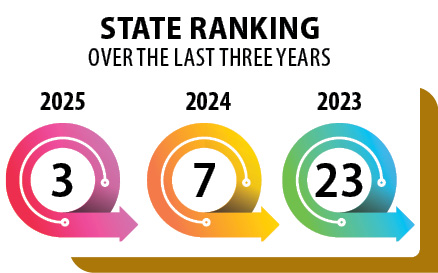
In the mountains, you don’t sprint to the summit. You climb steadily, adjusting to the terrain, measuring every step. Uttarakhand’s rise to #3 nationally in the SKOCH State of Governance Report 2025 feels much the same, deliberate, cumulative and hard-earned.
In the mountains, you don’t sprint to the summit. You climb steadily, adjusting to the terrain, measuring every step. Uttarakhand’s rise to #3 nationally in the SKOCH State of Governance Report 2025 feels much the same, deliberate, cumulative and hard-earned.
For the first time since cumulative rankings began in 2014, the state has entered the top five. That headline number, however, tells only part of the story. Beneath it lies a broader shift – a government that has widened its reform footprint across sectors, districts and municipalities.
From the Margins to the Main Table
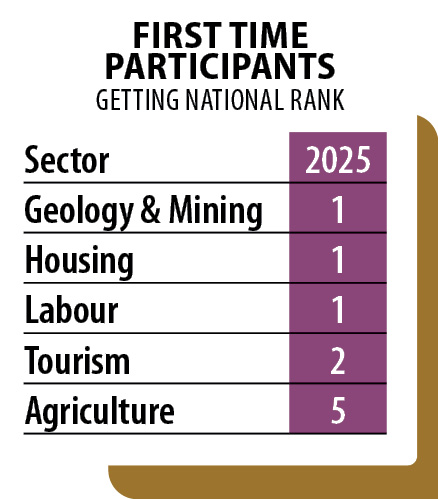
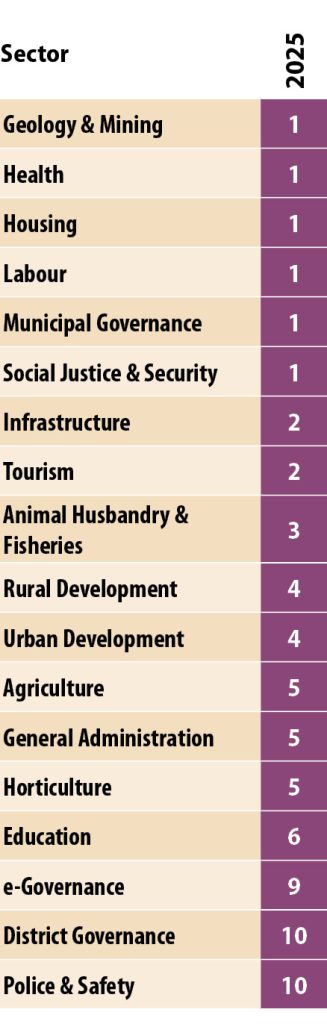
A decade ago, Uttarakhand was rarely discussed as a national governance frontrunner. The 2025 ranking marks a structural moment, not a spike, but a consolidation. A total of 43 well-performing projects qualified for deeper study this year. The state now tops the country in Geology & Mining, Health, Housing, Labour, Municipal Governance and Social Justice & Security. Each of these categories reflect a different layer of administration.
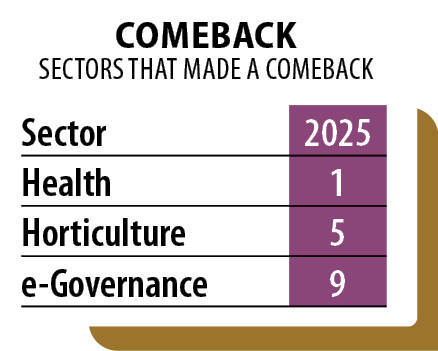
In Health, Uttarakhand ranks #1 nationally. For a geographically fragmented state, delivering consistent healthcare is a logistical challenge. Strong performance here signals coordination between district hospitals, frontline workers and administrative systems, rather than isolated medical upgrades.
In Municipal Governance, where the state also tops nationally, local bodies have emerged as reform drivers. A number of diverse projects were studied from Municipal Governance and Districts. That decentralised participation is telling: improvement is not confined to the state secretariat. Meanwhile, in Social Justice & Security, another top-ranked category, the state appears to have tightened welfare systems, a critical step in regions where remoteness can slow service access.
The state is increasingly defined by systems, digitised oversight in mining, structured welfare frameworks, empowered municipal bodies, participatory rural planning and strengthened health governance
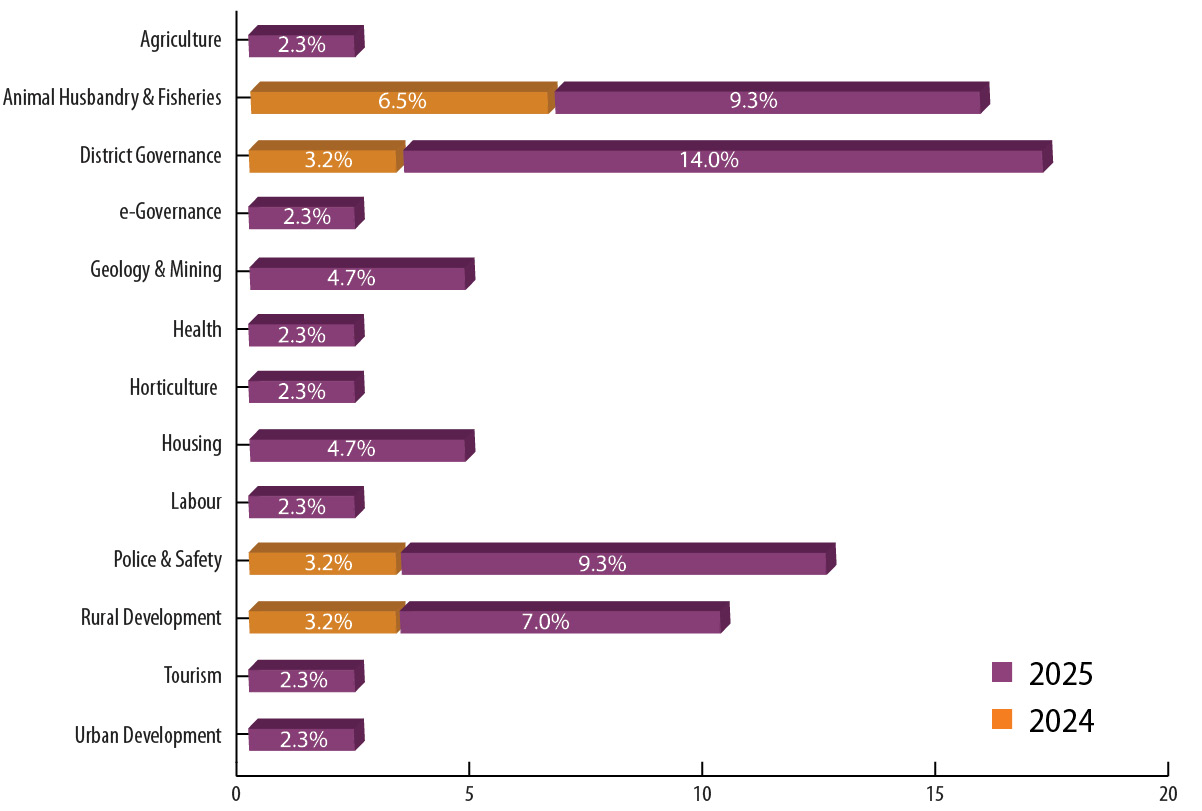
Sectors with Enhanced Focus – Uttarakhand
Governance Beyond the Secretariat
One of the features of Uttarakhand’s 2025 performance is decentralisation. Municipal bodies and district administrations were not passive participants; they were central drivers.
Urban bodies in particular demonstrated renewed confidence. Municipal Governance emerged as one of the state’s strongest areas, reflecting tighter waste management systems, improved public space management and more structured service delivery. In a state where tourism and pilgrimage swell city populations seasonally, urban systems are constantly tested. Strengthening municipal oversight has therefore become central to governance resilience.
Development initiatives are designed to cover all sectors and regions, with special focus on border areas to ensure last-mile delivery of government benefits. Uttarakhand’s approach emphasises inclusive growth, efficient governance and timely execution of projects, while strengthening social and economic infrastructure to create balanced and sustainable progress
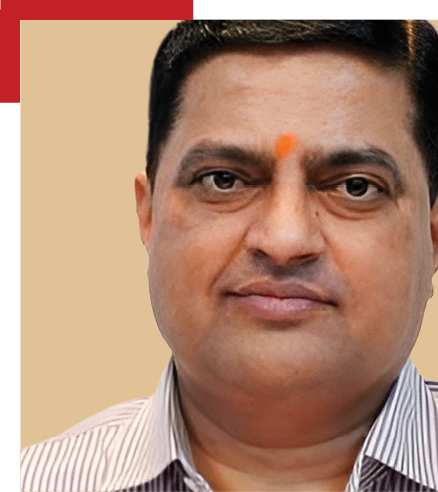
Pushkar Singh Dhami Chief Minister, Uttarakhand
Health with Structure, Not Symbolism
Health is another area where Uttarakhand’s performance stood out. In a geographically fragmented state, delivering consistent healthcare requires more than infrastructure; it requires coordination. The emphasis on structured governance frameworks including mental health governance aligned with the Mental Healthcare Act, 2017 suggests that reform extended beyond routine medical services.
LCCMS
Sridhar Babu Addanki
Secretary Uttarakhand Building and Other Construction Workers Welfare Board
In early 2023, the Department identified that welfare delivery was being throttled by delayed assessments and a total lack of transparency. To fix this without a massive price tag, leadership opted for a Low-Code/No-Code platform called Labour Cess Collection Management System (LCCMS). This agile approach allowed for zero-cost implementation and rapid development, ensuring that even non-technical staff could navigate the new digital landscape with ease. By mid-2024, the portal was fully operational, introducing a level of efficiency previously unseen in the sector. It enabled establishment registrations within 24-hours and slashed the issuance time for cess certificates to just seven days.
With states like Rajasthan and Uttar Pradesh now seeking to replicate the model, LCCMS has proven that digital transformation when executed with a focus on integration and simplicity is the most effective tool for ensuring social equity and administrative accountability.
By incorporating child and adolescent mental health into formal policy frameworks, the state signalled that health governance must be comprehensive.
For a region where remote communities can struggle with access, system-driven health administration becomes a backbone rather than a supplement.
Development of ICCC for Waste Management
Namami Bansal
Municipal Commissioner Nagar Nigam Dehradun
The project’s rollout began with a rigorous baseline study of collection routes and manpower deployment. This data informed the creation of a physical command centre equipped with GPS integration and advanced analytics. By consolidating waste-generation data, route schedules and vehicle tracking into a single digital platform, the municipality eliminated information gaps.
By teaching personnel how to navigate GPS tools and operational dashboards, the city reduced resistance to change and improved on-ground performance. The results were transformative: waste collection efficiency surged from a baseline of 46% to over 80%. Furthermore, the platform facilitated better interdepartmental alignment, allowing different agencies to collaborate using shared data rather than working in isolation. The ICCC serves as the backbone of Dehradun’s sustainable governance strategy.
Regulating Growth in Sensitive Terrain
Perhaps the most striking aspect of the 2025 performance is leadership in sectors that demand regulatory strength.
Geology & Mining, Housing and Labour, all areas where Uttarakhand participated robustly, reflect administrative confidence. Mining in a fragile ecological zone requires digital oversight and traceability. Housing demands balancing private participation with public accountability.
Leadership across welfare sectors, rapid improvement in rural and urban development and top ten entry in new areas like agriculture and tourism signal Uttarakhand’s expanding governance capability and outcome-oriented reform momentum
Mining Digital Transformation and Surveillance System (MDTSS)
Rajpal Legha
Director Geology and Mining Department
Historically, the sector was plagued by revenue leakage and unauthorised mineral transportation, which manual check posts struggled to contain. By transitioning to a data-driven governance model, the department aimed to create a unified, transparent ecosystem where every ton of mineral moved is tracked, validated and accounted for in real-time, ensuring both environmental compliance and fiscal protection.
The technical core of MDTSS is a sophisticated integration of specialised software and field-level hardware. The system utilises a modular suite covering e-Services, Mineral Management and real-time Mineral Marts. On the ground, this software is linked to RFID-enabled check gates, Automatic Number Plate Recognition (ANPR) cameras and GPS trackers. This allows for the automated validation of transit passes and e-challans; any vehicle attempting to bypass protocols.
eASE App
It serves as a unified digital roof for administrative, financial and citizen-facing services, aiming to modernise housing governance across all development authorities in Uttarakhand. Before eASE, the housing sector struggled with manual processing and a lack of transparency. Key issues included significant delays in building map approvals, a high pendency rate in administrative decisions and the absence of formal grievance redressal or RTI tracking. The lack of employee tracking and data silos hampered operational accountability and slowed down service delivery.
UHUDA developed a “faceless, paperless and cashless” platform featuring 12 specialised modules.
The state’s performance in these categories indicates that governance is no longer reactive. It is structured, monitored and increasingly technology-enabled.
Rural and Urban: Moving Together
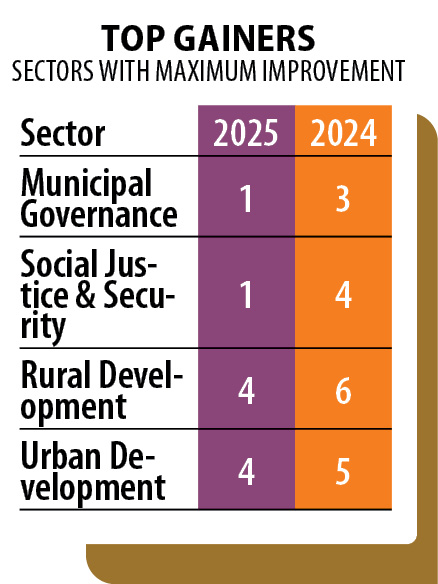
If there is one signal of strategic alignment in 2025, it is the simultaneous improvement in Rural Development and Urban Development. Uttarakhand recorded its maximum gains in these two foundational categories.
After periods of uneven performance, e-Governance saw a revival, with the state re-entering the national top ten. Digital governance often determines how citizens experience the state through service portals
In the hills, rural development is inseparable from migration. Villages need roads, livelihood opportunities and participatory planning to remain viable. Urban centres, meanwhile, must handle expanding populations and tourism pressures without overwhelming infrastructure.
Child-Mental Health
The initiative began with the release of the Child-Adolescent Mental Health Survey Report, which provided the state’s first evidence-based baseline of prevalence patterns and service gaps among vulnerable youth. The project’s implementation focused on creating a uniform administrative hierarchy, clearly defining roles for State and District Nodal Officers. To ensure compliance with national standards, the department developed standardised reporting formats and screening tools. A series of orientation and sensitisation workshops were held to train district teams on these new escalation channels and monitoring processes.
Pre-Recruitment Training for Wards of Ex-Servicemen
Amrit Lal
Director Directorate Sainik Kalyan
Uttarakhand, historically a significant contributor to India’s armed forces, recognised that the children of veterans often lacked the structured preparation and financial backing required for modern recruitment standards in the Army, Police and Paramilitary forces. This eight-week residential programme provides aspirants with free accommodation, professional coaching and specialised nutrition, bridging the gap between raw potential and the rigorous demands of military selection.
A key innovation was the introduction of honorariums for trainers and incentives for successful candidates, which significantly boosted morale and recruitment success rates. The physical readiness and institutional motivation has countered declining enrollment trends in remote areas. This has transformed from a simple coaching class into a critical support system for over 2,500 beneficiaries, significantly enhancing selection rates in the state.
Climbing in both categories suggests that the state is no longer treating rural and urban governance as competing priorities. Instead, it is synchronising them strengthening Gram Panchayat planning processes while improving municipal management.
The rise in these sectors represents more than statistical movement. It indicates an administrative pivot toward integrated development.
Digital Systems Regain Ground
After periods of uneven performance, e-Governance saw a revival, with the state re-entering the national top ten. Digital governance often determines how citizens experience the state through service portals, licensing systems and grievance redressal platforms.
A recovery here suggests backend consolidation and improved interoperability across departments. In smaller states, where scale can limit technical resources, sustained digital momentum is particularly noteworthy.
Affordable Housing by Private Developer on Private Land
R Meenakshi Sundaram
Principal Secretary-Planning & Director Uttarakhand Awas Evam Vikas Parishad
The UKAVP has pioneered a transformative housing model under the Pradhan Mantri Awas Yojana (Urban). By incentivising private developers to utilise their own land for public welfare, the state has successfully bypassed the chronic challenge of government land scarcity, creating a scalable roadmap for inclusive urban growth.
Uttarakhand faced a dual crisis: a massive unmet demand for housing among the EWS and a severe lack of contiguous government land suitable for large-scale development. UKAVP introduced a PPP framework where private developers contribute land and manage construction in exchange for streamlined statutory clearances and state-fixed pricing.
To ensure financial feasibility, the state facilitated central and state subsidies. A dedicated online portal was launched to manage the “faceless” allotment of units, ensuring transparency. This has resulted in the creation of 12,856 EWS units.
Uttarakhand’s improvement in Horticulture, where it secured a top five national position, reflects renewed attention to the hill economy. Fruit cultivation, high-value crops and sericulture form important pillars of rural income
Hill Economy Responds
Uttarakhand’s improvement in Horticulture, where it secured a top-five national position, reflects renewed attention to the hill economy. Fruit cultivation, high-value crops and sericulture form important pillars of rural income. Strengthening these sectors requires coordinated extension services and value-chain support.
The state’s entry into Agriculture as a first-time participant and its immediate placement within the top five further underline a maturing approach. Agriculture in Uttarakhand is shaped by small landholdings and terrain constraints. Strong performance here suggests targeted interventions rather than blanket expansion.
Decade in the Making
The cumulative ranking from 2014-25 underscores that 2025 is not an anomaly. Uttarakhand’s governance story has been unfolding over multiple cycles. There were earlier pockets of excellence, strong sectoral performances here and there. What distinguishes this year is convergence. Leadership in six categories, strong gains in development sectors, revival in digital governance and confident entry into new domains together created momentum.
For years, Uttarakhand’s governance narrative was framed around its challenges, disaster vulnerability, migration, ecological fragility. The 2025 assessment reframes that story. Its rise into the top three nationally is not a sudden leap but the result of cumulative tightening across sectors.
In a country where scale often complicates delivery, Maharashtra’s experience underscores a central lesson: sustained governance is built not on singular achievements, but on the cumulative effect of many well-executed...
For the third time, Andhra Pradesh leads the nation in governance outcomes. It affirms a model defined by scale, sustained impact and institutional strength where performance is consistent, improvement continuous...
India’s governance story in 2025 is best understood not through intent, announcements or policy volume, but through outcomes that can be measured, verified and experienced by citizens.
India’s public institutions are undergoing a quiet transformation. Across sectors from railways and manufacturing to public health and defence, digital systems, predictive technologies and citizen engagement are reshaping governance. These...