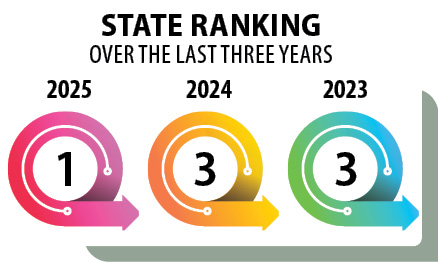
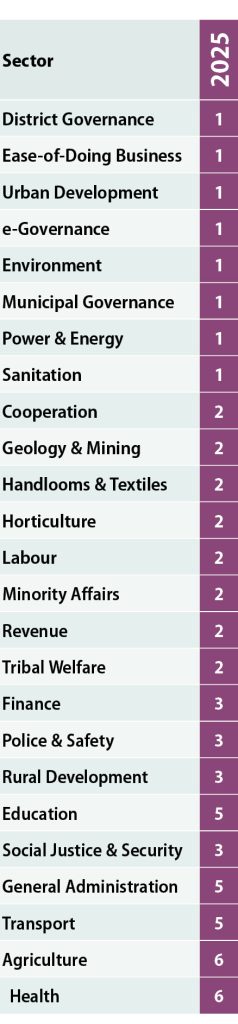
For the third time, Andhra Pradesh leads the nation in governance outcomes. It affirms a model defined by scale, sustained impact and institutional strength where performance is consistent, improvement continuous and excellence no longer episodic
In a decade marked by fiscal stress, institutional churn and rising citizen expectations, Andhra Pradesh has quietly built something rare in Indian public administration: a governance system that performs across sectors, across years and across levels of government.
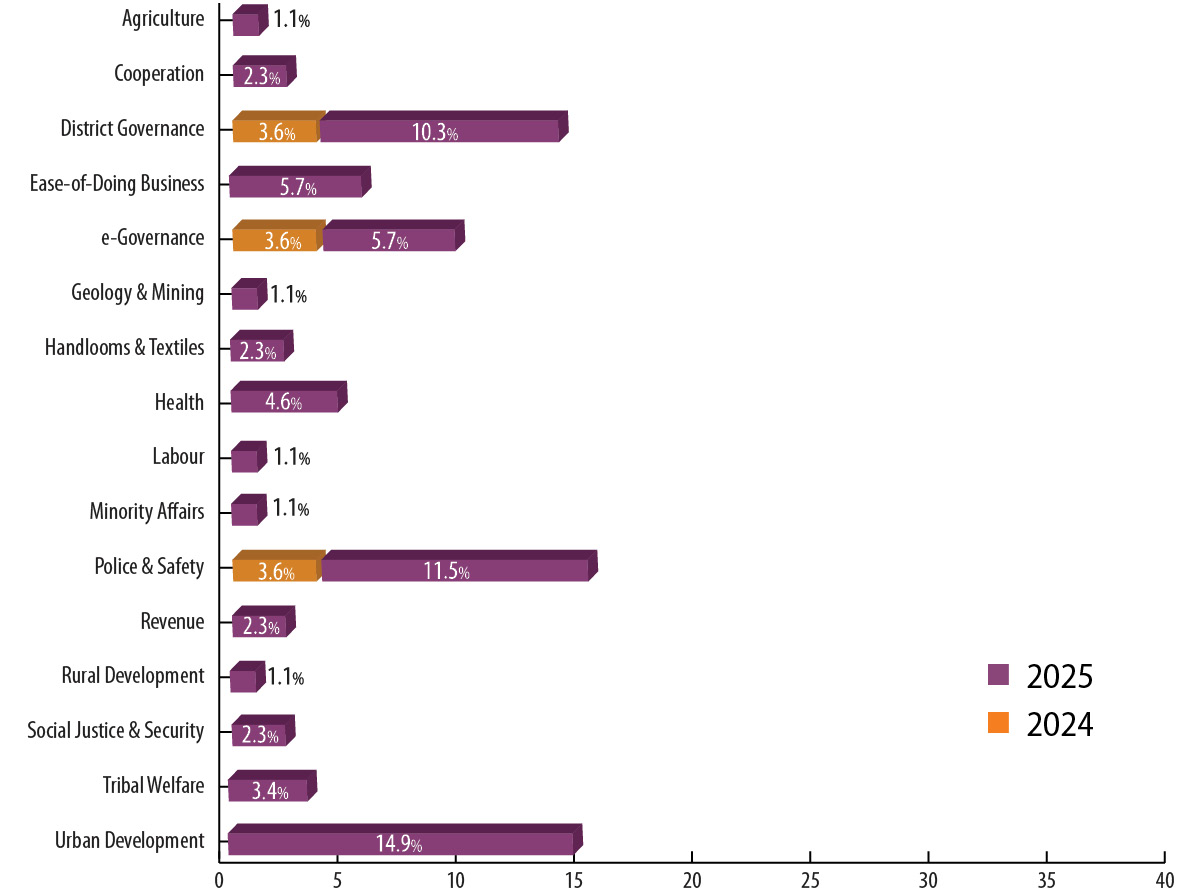
The SKOCH State of Governance Report 2025 places Andhra Pradesh at the very top nationally – for the third time. But rankings alone do not explain what is unfolding in the state. What stands out instead is the breadth of performance, the depth of recovery in difficult sectors and the consistency with which governance outcomes are being delivered. Eighty-seven well-performing projects this year qualified for deeper study. This is not the story of a single reform or a headline-grabbing scheme. It is the story of how governance, in Andhra Pradesh, has increasingly become institutionalised.
Governance That Reaches the Districts
One of the clearest signals of Andhra Pradesh’s governance strength lies not in the state secretariat, but in its districts and cities.
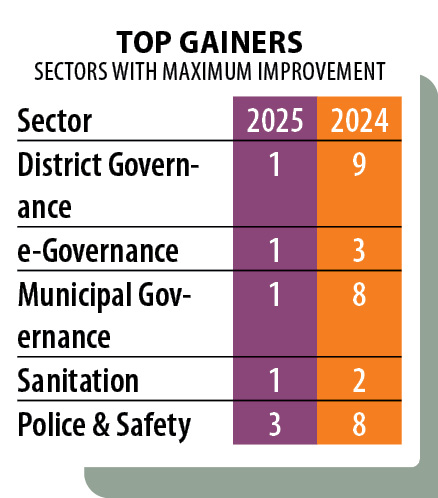
The state leads the country in District Governance and Municipal Governance, reflecting a model where decision-making, monitoring and service delivery are actively pushed closer to citizens. This decentralised emphasis is visible in the volume and quality of initiatives emerging from district administrations and urban local bodies.
From digitally enabled grievance redress systems to data-driven monitoring of municipal services, district-level governance in Andhra Pradesh has moved beyond compliance to performance. Urban local bodies, in particular, have demonstrated the ability to plan and execute interventions in sanitation, urban infrastructure and civic service delivery with measurable outcomes.
The state leads the country in District Governance and Municipal Governance, reflecting a model where decision-making, monitoring and service delivery are actively pushed closer to citizens. This decentralised emphasis is visible in the volume and quality of initiatives emerging from district administrations and urban local bodies
This district-centric approach explains why sectors such as Sanitation, Urban Development and e-Governance show strong and sustained results. Governance here is not episodic; it is continuous and local.
e-Governance as the Operating Backbone
Andhra Pradesh’s leadership in e-Governance is not defined by isolated digital platforms but by how technology has been woven into everyday administration. Across departments, digital tools are being used to track service delivery, manage beneficiary databases, monitor project progress and reduce discretion at the cutting edge. This has had a cascading effect – improving transparency, shortening response times and enabling data-backed decision-making.
In sectors such as revenue administration, municipal services and policing, technology has shifted governance from reactive to anticipatory. Dashboards, integrated databases and real-time reporting systems allow administrators to identify bottlenecks early and intervene before service failures escalate. What distinguishes Andhra Pradesh is not digitisation for its own sake, but functional digitisation – technology that changes how institutions behave.
Quiet Transformation
Few sectors reflect the complexity of governance more than Police & Safety. It is a domain shaped by public trust, operational readiness and institutional culture.Andhra Pradesh’s strong performance in policing reflects sustained improvements across multiple dimensions: adoption of technology-enabled policing tools, improved emergency response mechanisms, enhanced surveillance and communication systems and better coordination between field units and command centres.
In 2025, we achieved positive outcomes, met citizens’ expectations and rebuilt trust in government systems. Through Annadata Sukhibhava and Deepam 2.0, support reached millions, while pensions expanded significantly. Around 70 major schemes were successfully implemented, strengthening welfare and development. The upcoming Quantum Valley in Amaravati reflects a forward-looking vision for growth
N Chandrababu Naidu Chief Minister, Andhra Pradesh
Citizen-facing initiatives – such as digital complaint registration, improved response times and data-led deployment – have strengthened accountability while improving operational efficiency. The emphasis has clearly shifted from reactive enforcement to proactive public safety. Importantly, these gains are not confined to metropolitan areas. District-level police units have been active participants in reform, reinforcing the state’s broader decentralised governance model.
Transforming Urban Livelihoods
Tej Bharath N
Mission Director Mission for Elimination of Poverty in Municipal Areas (MEPMA)
The Bank Linkage Scheme is the starter motor. By simplifying documentation, aligning banks through SLBCs and using micro-credit planning to nudge loans toward income generation, SHGs access large, collateral-free credit with outstanding repayment (~99.5%) and an estimated state share of nearly a third of India’s total, trust institutionalised at scale. With rates lowered and up to Rs 20 lakh possible per SHG, the credit is not an end; it is designed to be the first mile of enterprise. For those producing goods, markets are widened by empowering SHG Women through E-Commerce. A statewide drive, timed to International Women’s Day, mobilises listing, packaging, fulfilment and campaign sales targeting Rs 1 lakh orders and 1 crore in a single day, built on ONDC and partner marketplaces.
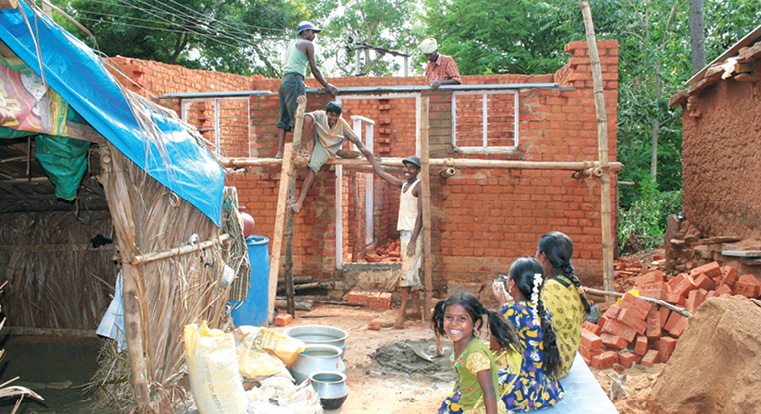
NIVASAM (Shelter for Urban Homeless) constructs that dignity with a modern backbone: statewide enumeration, 90+ shelters, CCTV and a real-time dashboard for occupancy, grievance redressal, health linkages and timely payments to operating NGOs. The shelter is more than a bed; it is a re-entry station.
Residents are screened for skill programmes, routed to VOG/CIGs or SHGs where possible, linked to PM-SVANidhi if they vend and supported in ID/documentation converting vulnerability into inclusion.
It is one ecosystem in which every intervention is a doorway to the next and where evidence dashboards, recovery data and market telemetry allow course-correction in real time.
What distinguishes Andhra Pradesh is not digitisation for its own sake, but functional digitisation – technology that changes how institutions behave
Sectors with Enhanced Focus – Andhra Pradesh
Digitalisation of APCO
G Rekha Rani
Vice-Chairman & MD Andhra Pradesh State Handloom Weavers Cooperative Societies
The project’s implementation was divided into two critical streams: market expansion and office automation. First, the launch of a dedicated e-commerce platform allowed APCO to bypass the geographical limitations of its physical stores, bringing authentic handloom products to a global audience. Simultaneously, the organisation automated its backend through customised software that integrated procurement, payroll and accounting. This shift was supported by advanced tools, such as facial recognition attendance systems and a centralised data repository, which replaced fragmented reporting with real-time, high-integrity analytics.
Navigating this transition required a robust focus on change management. The leadership addressed initial staff resistance through intensive training and hands-on support, ensuring that technical expertise was built within the existing workforce.
By merging ancient craftsmanship with modern digital tools, the organisation has strengthened its market presence and enhanced internal accountability. The project proves that technology-driven governance is the most effective way to sustain social objectives.
Swarna Naravaripalli
Launched in late 2024 by the Tirupati District Administration, the Swarna Naravaripalli project serves as a landmark model for rural Net-Zero energy transition. Spanning three Gram Panchayats, the initiative aligns with the national PM Surya Ghar: Muft Bijli Yojana, aiming to convert entire rural settlements into self-sustaining, clean energy hubs.
The rollout faced significant logistical hurdles, including procurement delays and documentation mismatches in government service records. These were resolved through intensive field verification, coordinated by a dedicated Special Officer and seamless integration with existing government databases to ensure no household was left behind. The environmental and economic results are profound. The project is expected to generate 48 lakh units of electricity annually.
Stability in a Difficult Sector
Energy governance is often a stress test for state capacity. Financial pressures, infrastructure demands and regulatory complexity make sustained performance difficult.
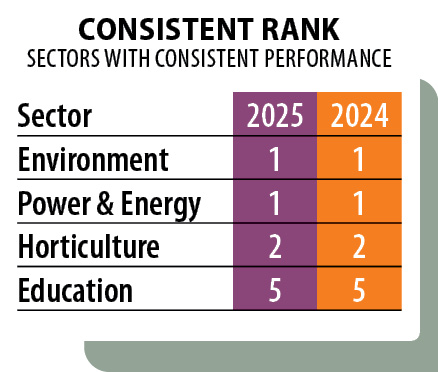
Andhra Pradesh stands out for maintaining top-tier performance in Power & Energy over multiple years.
Andhra Pradesh demonstrates how governance becomes durable when systems outperform slogans, districts drive delivery, technology enables accountability and consistency across sectors translates policy intent
This reflects a combination of improved utility management, better monitoring of generation and distribution and efforts to balance financial viability with service reliability.
Operational improvements – such as tighter billing systems, reduction of technical losses and technology-driven monitoring – have strengthened the sector’s institutional foundations.
2MW Floating Solar Farm – A Green initiative
Ketan Garg
Commissioner Greater Visakhapatnam Municipal Corporation
This project addresses a classic urban constraint: the scarcity of land for large-scale solar installations. By utilising the water surface, the corporation avoided the need to divert valuable land resources, instead opting for a model that combines energy production with environmental preservation. The project was conceived not just as a power plant, but as a strategic asset to improve reservoir health and energy efficiency.
A critical phase involved the design of the flotation and anchoring systems, which had to ensure structural stability without disrupting the natural exchange of light and gases within the water body. Close coordination with state power utilities was essential to secure grid connectivity and permissions.
The final design features 6,250 dual-glass modules spread across 17,500 square meters, optimised for maximum solar absorption while maintaining the ecological integrity of the reservoir. The plant generates approximately 3,613 MWh annually, drastically reducing dependence on external grid power and fossil fuels.
Atchutapuram SEZ
Prior to the SEZ’s development, the regional economy suffered from an over-reliance on a narrow industrial base and a lack of port-linked competitiveness. Coastal infrastructure was insufficient to attract global players and there were few mechanisms to integrate MSMEs into larger industrial value chains.
APIIC adopted a holistic approach, providing world-class infrastructure including 36 km of internal roads, 100 MW of power and 60 MLD water supply. A critical differentiator was the Social Impact & Rehabilitation programme, which successfully integrated 5,129 displaced families into the new ecosystem by providing housing, schools and hospitals.
At the same time, energy planning has been aligned with broader development goals, ensuring that power availability supports industrial growth, urban expansion and rural livelihoods.
Consistency in this sector points to governance maturity: systems that hold even when conditions are challenging.
Andhra Pradesh Micro Irrigation Project
Vinod Kumar V
Collector and District Magistrate, Ananthapuramu
The Andhra Pradesh Micro Irrigation Project (APMIP) in Ananthapuramu serves as a definitive case study in climate-resilient agriculture. Located in one of India’s most arid districts, the region historically struggled with red soil, erratic rainfall and rapid groundwater depletion. These factors previously limited farmers to low-yield crops like groundnut, where inefficient flood irrigation and high labour costs often led to financial distress. To reverse this, the state integrated the Pradhan Mantri Krishi Sinchai Yojana (PMKSY) to transition from water-intensive methods to high-value horticultural precision.
Targeted support, ranging from 90% to 100% for marginalised farmers, lowered the entry barrier, while the APMIP mobile app streamlined registration and geo-tagging across 453 Rythu Seva Kendras. A critical technical component is precision fertigation, which utilises water-soluble fertiliser kits to deliver nutrients directly to the root zone.
The results from the 2024-25 highlight a turnaround: Ananthapuramu now ranks first in the state and second in India for micro-irrigation adoption. Beyond the numbers, the project has achieved a 50% reduction in power consumption and a 20% drop in fertiliser consumption.
Citizen-facing initiatives – such as digital complaint registration, improved response times and data-led deployment have strengthened accountability while improving operational efficiency
Governance Beyond Infrastructure
Environmental governance and sanitation are often treated as infrastructure challenges. Andhra Pradesh’s performance suggests a deeper approach, one that integrates planning, behaviour change and monitoring.
In Sanitation, the state’s leadership reflects coordinated action at the municipal and community levels. Urban sanitation initiatives have combined infrastructure creation with service delivery monitoring, ensuring that outcomes are sustained rather than symbolic.
Environmental governance, meanwhile, has benefited from structured planning and enforcement mechanisms. Monitoring systems, regulatory compliance and inter-departmental coordination have helped maintain consistent performance in a sector where results are typically uneven.
Together, these sectors reveal a governance philosophy that looks beyond asset creation to outcome durability.
Recovery with Direction
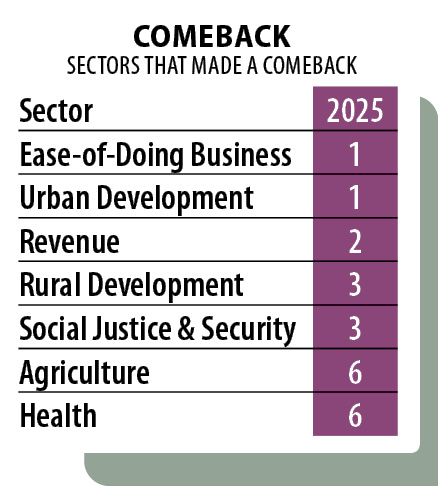
Some of the most telling achievements of Andhra Pradesh lie in sectors that demanded recovery rather than maintenance.
Across policing, power, urban services, welfare and environment, Andhra Pradesh shows recovery without disruption, decentralisation without dilution and reform without spectacle
In Revenue, improved administrative processes and tighter monitoring have helped the state regain strong national standing. Digitisation, data integration and improved compliance mechanisms have strengthened fiscal administration without resorting to ad-hoc measures.
Rural Development and Social Justice & Security reflect a similar trajectory. Governance systems in these sectors have focused on better targeting, streamlined delivery and improved coordination between departments. Welfare programmes are increasingly managed through integrated platforms that reduce leakages and improve beneficiary experience.
Energy Portfolio Management System
The Implementation of the Energy Portfolio Management System (EPMS) by APTRANSCO and the State Load Despatch Centre (SLDC) marks a pivotal shift toward AI-driven power governance in Andhra Pradesh.
By replacing manual, siloed planning with an integrated digital ecosystem, the state has enhanced its ability to maintain grid reliability while aggressively optimising procurement costs.
During its development phase in early 2025, optimisation engines were configured to account for real-world generator constraints, such as ramp rates and technical minimum limits. This allows for sophisticated “unit commitment,” ensuring the most cost-effective mix of power sources is utilised at any given time.
Furthermore, the system’s automated bid generation allows SLDC to participate in power exchanges with unprecedented speed and accuracy, ensuring optimal market positioning in day-ahead and real-time horizons.
Deployment involved a rigorous transition period, including capacity building for SLDC personnel and the refinement of models to account for seasonal weather variations.
The implementation of centralised dashboards has provided operators with total situational awareness, transforming raw data into actionable insights for grid stability.
Some of the achievements of the state lie in sectors that demanded recovery rather than maintenance. In Revenue, improved administrative processes have helped the state regain strong national standing
Entrepreneurship and Livelihood
The core of the project involves entrepreneurship-oriented training that focuses on the entire production lifecycle from hygienic processing to professional packaging and basic business management.
By introducing these modern standards, the AP Girijan Cooperative Corporation has empowered tribal individuals to move beyond the role of raw material collectors to become micro-entrepreneurs. A major breakthrough was the implementation of a transparent, organised procurement system. This mechanism effectively eliminated exploitative middlemen by ensuring that tribal producers receive fair prices directly from the Corporation.
Beyond procurement, the initiative emphasises localised value addition. Raw forest produce is processed and packaged to meet retail standards, significantly increasing its market value and the subsequent returns to the producers.
These products are then showcased through the Corporation’s retail outlets and exhibitions, providing tribal communities with consistent demand and high visibility.
This structured approach has increased household incomes and built significant confidence among the producers to participate in the broader digital and physical economy.
In sectors shaped by external variables, climate, markets and demographic pressures – Andhra Pradesh has delivered steady performance.Agriculture governance has focused on service delivery that supports farmers
Online Waste Exchange Portal
Rajendra Prasad Khajuria
Managing Director, APEMCL
The platform functions as a secure ecosystem connecting waste generators, authorised receivers and registered transporters. A critical technical innovation is the integration of a GPS-enabled Vehicle Tracking System (VTS), which provides real-time monitoring of waste movement to prevent unauthorised diversion. Furthermore, the initiative introduced a specialised Marine Monitoring Application to regulate effluent discharge into the sea, ensuring that industrial disposal remains within strict environmental compliance limits.
Following its successful launch, the system underwent phased upgrades, including a dedicated fly ash utilisation module in 2022 and enhanced Management Information Systems (MIS) in 2024. These improvements addressed initial challenges such as digital adoption resistance and stakeholder coordination through continuous training and responsive support. The portal’s success is rooted in its ability to convert complex compliance data into actionable monitoring tools, allowing the state to oversee hazardous waste from “cradle to grave.”
AP Resurvey Project
To achieve millimetre-level accuracy, the AP Resurvey Project by Survey Settlements & Land Records, deployed a sophisticated multi-tiered technological framework. High-precision aerial mapping is conducted via drones, while ground verification is managed through GNSS Rovers supported by a network of Continuously Operating Reference Stations (CORS). Powering this digital overhaul is the Integrated Land Information Management System (ILIMS), a real-time backbone that facilitates “faceless” and “paperless” updates. This infrastructure, supported by a dedicated mobile application for field monitoring, ensures that all data adheres to strict operational protocols, even when navigating difficult terrain or technical equipment hurdles.
The impact of this initiative has been unprecedented, with nearly seven thousand villages resurveyed and eighty-one lakh land parcels digitised by early 2025. The project’s proactive approach allowed for the resolution of over eighty-six thousand boundary disputes during the survey process itself, significantly reducing the burden on the judiciary.
Plastic Free AP Secretariat
Before this intervention by Swachha Andhra Corporation, the Secretariat mirrored the broader challenge of high single-use plastic consumption, generating significant volumes of non-biodegradable waste.
By prioritising the Secretariat as a flagship demonstration site, the state government aimed to prove that large-scale institutional shifts toward environmental sustainability are both operationally feasible and socially acceptable.
The project’s success relied on a dual strategy of strict policy enforcement and infrastructure upgrades. Every employee was provided with a stainless-steel water bottle, effectively eliminating thousands of disposable units daily.
For visitors, the administration established an innovative in-house water cleaning, refilling and sealing plant to supply reusable glass bottles. This shift was supported by the installation of stainless-steel dustbins equipped with biodegradable liners, ensuring that the entire waste-handling chain remained eco-friendly.
To sustain this behavioural shift, the initiative integrated socio-economic empowerment with environmental goals.
This was accompanied by a persistent communication campaign utilising posters, pillar boards and regular sensitisation sessions to build collective ownership among the 3,000 internal stakeholders and numerous daily visitors.
In Health, the emphasis on systems, monitoring, access and administrative coordination has helped the state perform strongly despite post-pandemic pressures. Horticulture stands out for consistency
SMART Kitchen Project
Sreedhar Cherukuri
Collector & District Magistrate YSR Kadapa
The SMART (Safe, Modern, Automated, Reliable, Transparent) Kitchen Project is a transformative overhaul of the Mid-Day Meal Programme. Recognising that the traditional decentralised model led to inconsistent hygiene and poor oversight, the district moved toward a sophisticated Hub-and-Spoke model. This centralised approach ensures that high-capacity, high-tech kitchens provide uniform, nutritious and hygienic meals to a vast network of satellite schools, eliminating the infrastructure disparities that previously affected student health and trust.
The project is defined by its rigorous digital governance ecosystem. To ensure total accountability, the administration integrated CCTV surveillance, IoT-enabled temperature sensors and GPS tracking for delivery vehicles. This data flows into a Central Control Room, where officials monitor everything from cooking temperatures to last-mile delivery efficiency.
By August 2025, the first five kitchens began serving over 10,000 students, with a roadmap to reach 1.29 lakh children. This shift from manual record-keeping to real-time dashboards has drastically reduced service gaps and improved food safety standards across the district.
These recoveries are significant because they demonstrate governance adaptability, the ability to correct course without destabilising other sectors.
Managing Complexity
In sectors shaped by external variables, climate, markets and demographic pressures – Andhra Pradesh has delivered steady performance.Agriculture governance has focused on service delivery mechanisms that support farmers through timely interventions, advisory systems and institutional coordination. While the sector remains exposed to structural challenges, governance capacity has improved. In Health, the emphasis on systems, monitoring, access and administrative coordination has helped the state perform strongly despite post-pandemic pressures.
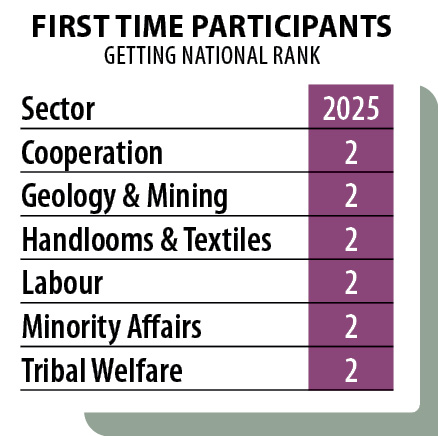
A distinct feature of Andhra Pradesh’s 2025 performance is how it handled first-time participation in multiple governance domains – such as cooperation, labour, handlooms and textiles, minority affairs, tribal welfare
PM-Surya Ghar UjLA for SC-ST Consumers
Kamalakar Babu M
Managing Director New & Renewable Energy Development Corporation of Andhra Pradesh Ltd
By aggregating procurement for 2 kW rooftop solar systems, the state achieved significant cost reductions and ensured a standardised, high-quality rollout for nearly 600,000 SC/ST families. Following a competitive bidding process in August 2025, specialised vendors were selected to execute the project across 84 administrative divisions.
The implementation phase is characterised by a disciplined 180-day execution timeline per installation. EPC vendors conduct site-specific surveys assessing structural integrity and solar isolation before installing systems that adhere to strict Domestic Content Requirements (DCR).
Beyond providing “Muft Bijli” (free electricity) to millions of beneficiaries, it is projected to save the state Rs 6,454 crore in power purchase costs over its 25-year lifecycle. By shifting focus toward renewable sources, the initiative significantly reduces carbon emissions and strengthens the domestic solar manufacturing ecosystem.
Horticulture stands out for consistency. Sustained performance here reflects long-term planning and stable institutional support, rather than short-term interventions.
Project ASTRAM
S V Rajasekhara Babu
Commissioner NTR Police Commissionerate
By fusing Artificial Intelligence (AI) with Geographic Information Systems (GIS), the city has addressed the chronic challenges of rapid urbanisation and escalating vehicular density.
Previously, Vijayawada’s traffic management suffered from fragmented manual policing and inconsistent enforcement, which led to significant congestion and delayed responses to road accidents. The absence of real-time data hindered the ability of administrators to predict traffic patterns or manage large-scale public events effectively.
To combat these issues, ASTraM introduced a centralised Operational Control Centre utilising cloud-native architecture.
The system prioritises public safety through emergency vehicle clearing protocols and maintains a direct link to the public via a companion mobile app and SMS alert system, providing real-time route recommendations to commuters.
Environmentally, the reduction in idling times has decreased vehicle emissions and fuel consumption. Operationally, automated enforcement has allowed for more efficient deployment of human resources.
Aware
AWARE (Advanced Warning and Advisory for Resilient Ecosystem) is an integrated disaster intelligence platform developed by the Real Time Governance Society (RTGS) of Andhra Pradesh. The platform consolidates real-time environmental data from 15+ departments, sensor networks and national and international agencies to enable AI-driven forecasting, risk assessment and multi-channel early warnings for citizens and officials. By transforming fragmented datasets into actionable insights, AWARE supports proactive decision-making, rapid response and disaster preparedness.
The system demonstrated its effectiveness during Cyclone Montha (Sept 2025). It generated 72-hour advance warnings, accurately predicting the cyclone path and issuing targeted alerts to 176 coastal mandals.
New Domains, Strong Starts
A distinct feature of Andhra Pradesh’s 2025 performance is how it handled first-time participation in multiple governance domains – such as cooperation, labour, handlooms and textiles, minority affairs, tribal welfare and mining-related administration.Entering these sectors without prior benchmarking, the state still achieved strong national positioning.
This suggests that core governance capabilities, planning, documentation, monitoring and execution are transferable across domains. In governance terms, this is a critical capability. As state responsibilities expand, the ability to absorb new mandates without performance erosion elsewhere becomes a key differentiator.
In a country where scale often complicates delivery, Maharashtra’s experience underscores a central lesson: sustained governance is built not on singular achievements, but on the cumulative effect of many well-executed...
India’s governance story in 2025 is best understood not through intent, announcements or policy volume, but through outcomes that can be measured, verified and experienced by citizens.
India’s public institutions are undergoing a quiet transformation. Across sectors from railways and manufacturing to public health and defence, digital systems, predictive technologies and citizen engagement are reshaping governance. These...
The SKOCH State of Governance Report is a highly anticipated and widely discussed publication that assesses the state of governance across India. Its distinctive focus on primary data and grassroots-level...