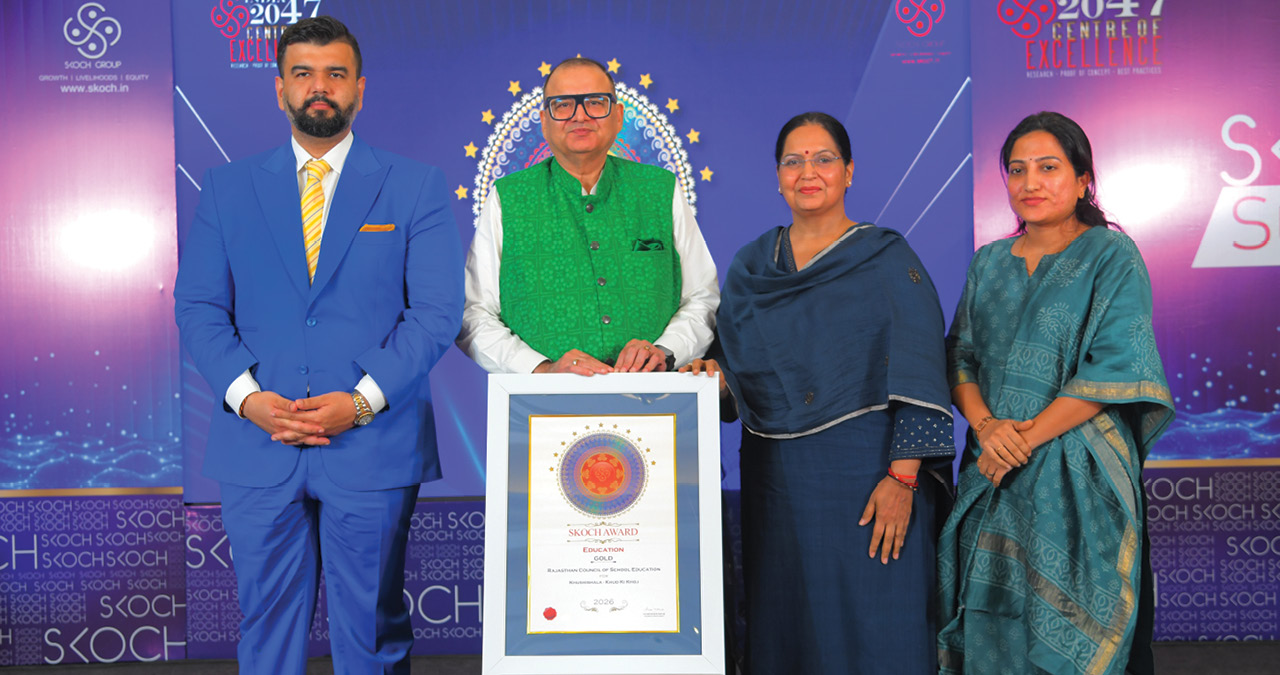
In Rajasthan’s government schools, an unusual educational experiment is unfolding: measuring what children know while strengthening how they feel and learn. A child still answers questions on paper, but a teacher can scan the answer sheet on a smartphone and artificial intelligence evaluates it. In another classroom, the focus shifts from marks to helping children understand emotions, express themselves and build confidence.
Together, AI-led Competency-Based Assessments (CBA) and Khushishala – Khud Ki Khoj demonstrate Rajasthan’s school reform in action: measuring what children know and strengthening how they feel and learn.
Launched in 2022, it covers 45 lakh students across 65,000 government schools, with 15 crore papers scanned using AI and four crore report cards distributed. Some 20 lakh parents have also been engaged in the learning process.
The reform tackles a fundamental problem. Earlier, assessments varied across schools; teachers spent time checking papers and entering data and conventional tests revealed little about a child’s reasoning. Rajasthan retained paper examinations, which are important where digital connectivity is weak, but teachers scan answer sheets using the Shikshak App. AI-OCR evaluates objective responses, while newer rubric-based technology assesses handwritten subjective answers in Hindi. The impact goes beyond administrative efficiency. More than four lakh children moved out of learning poverty, with an 8-10% reduction within a year.
Khushishala addresses something technology cannot easily measure: emotional well-being. Beginning in 2022-23, it integrates social-emotional learning into everyday teaching, rather than treating mental health as a separate intervention. Four teacher handbooks were developed, followed by training and a pilot covering 60 schools, 120 teachers, and about 1,350 students in Banswara and Sirohi.
97% of teachers reported confidence in facilitating the programme, while 53% of assessed students showed positive progress in well-being and socio-emotional skills. Among assessed girls, 69% showed significant positive growth.
Together, the two reforms show that Rajasthan’s educational reforms work best when they measure learning and foster classrooms where children feel secure enough to learn.
"American roads are good not because America..
State Rankings Highlights -: Odisha scaled to number..
Step 1: Call for Project Submission Call for..
In the run-up to the elections, the most..

Inclusion is the first magazine dedicated to exploring issues at the intersection of development agendas and digital, financial and social inclusion. The magazine makes complex policy analyses accessible for a diverse audience of policymakers, administrators, civil society and academicians. Grassroots-focused, outcome-oriented analysis is the cornerstone of the work done at Inclusion.