Solid waste management was among the most pressing issues. Years of unsegregated garbage posed health and environmental risks.
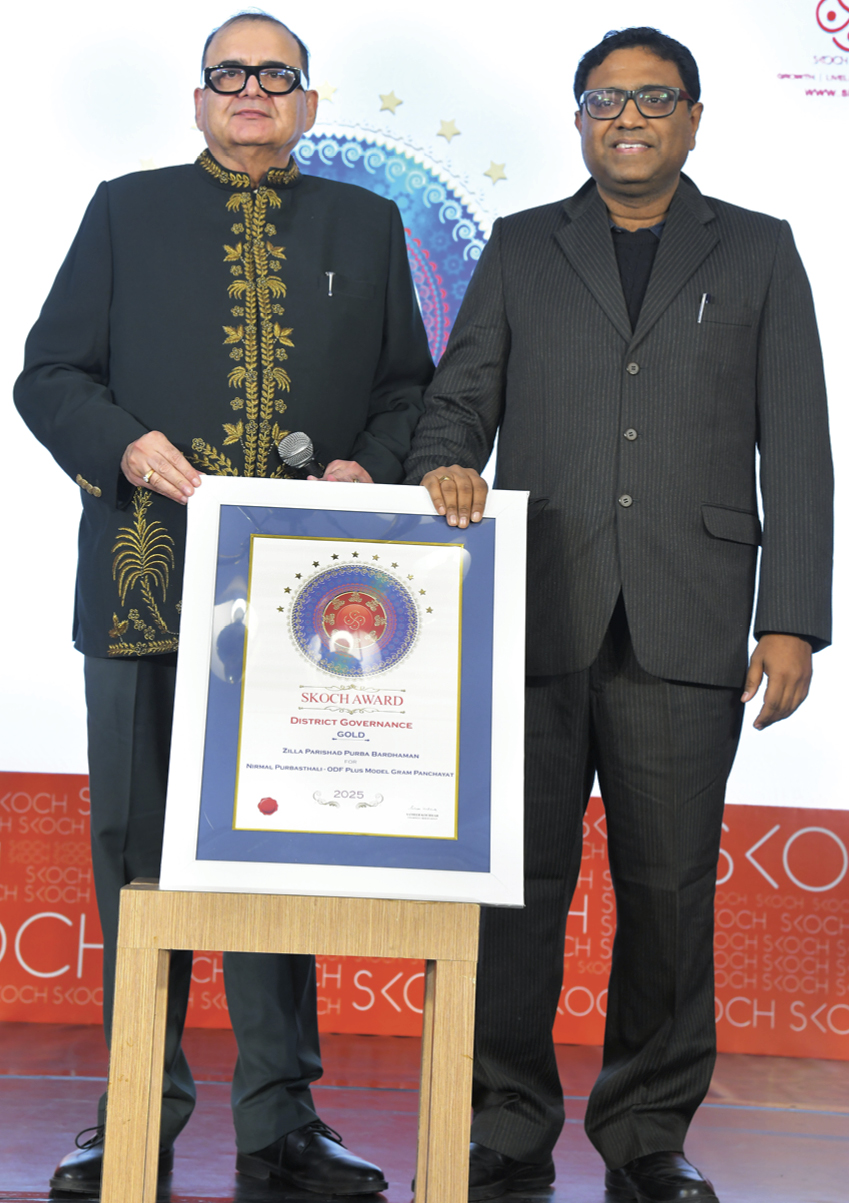
Once declared Open Defecation Free (ODF), Purabsthali Gram Panchayat faced a more complex challenge: moving beyond basic sanitation to become an ODF Plus Model village. While earlier efforts had focused on toilet construction, everyday realities revealed deeper gaps. Legacy waste remained unmanaged, public ponds were used as dumping sites, greywater flowed untreated. Achieving ODF Plus status required addressing both infrastructure gaps and entrenched behaviours.
Solid waste management was among the most pressing issues. Years of unsegregated garbage posed health and environmental risks. At the same time, untreated greywater from households drained into nearby land and water bodies, threatening local ecosystems. Resistance from sections of the community towards waste segregation, user fees and restrictions on single use plastic further complicated implementation.
All legacy waste was cleared and a dedicated Solid Waste Management unit was established. Door-to-door waste collection began across the Gram Panchayat, with segregation at source as its foundation. A nominal monthly subscription ensured financial sustainability. Toilets in households, schools, health centres and public institutions were repaired or rebuilt, reinforcing the importance of functionality and regular use.
Public ponds were cleaned using both machinery and manpower, restoring them as healthier community assets.
Liquid waste management introduced an innovative approach. Filter chambers and soak pits were constructed to treat greywater, allowing it to be safely absorbed and reused for gardening and cleaning. Community groups monitored these systems, fostering ownership and accountability.
Sustained awareness campaigns involving community workers, schools and volunteers gradually shifted behaviour.
Within months, Purabsthali achieved visible transformation: operational waste systems, functional toilets, reclaimed ponds and lasting behavioural change, demonstrating that sustainable sanitation depends on systems, sustainability and collective action.
Commissioned on 30 April 2024, the project has an annual generation potential of 58.1 million units with a capacity utilisation factor of 26.53 percent.
Affordable Housing by Private Developers on Private Land Uttarakhand Awas Evam Vikas Parishady
eASE App: Transforming Urban Governance Uttarakhand Housing and Urban Development Authority
"American roads are good not because America..
State Rankings Highlights -: Odisha scaled to number..
In the run-up to the elections, the most..
Step 1: Call for Project Submission Call for..

Inclusion is the first magazine dedicated to exploring issues at the intersection of development agendas and digital, financial and social inclusion. The magazine makes complex policy analyses accessible for a diverse audience of policymakers, administrators, civil society and academicians. Grassroots-focused, outcome-oriented analysis is the cornerstone of the work done at Inclusion.