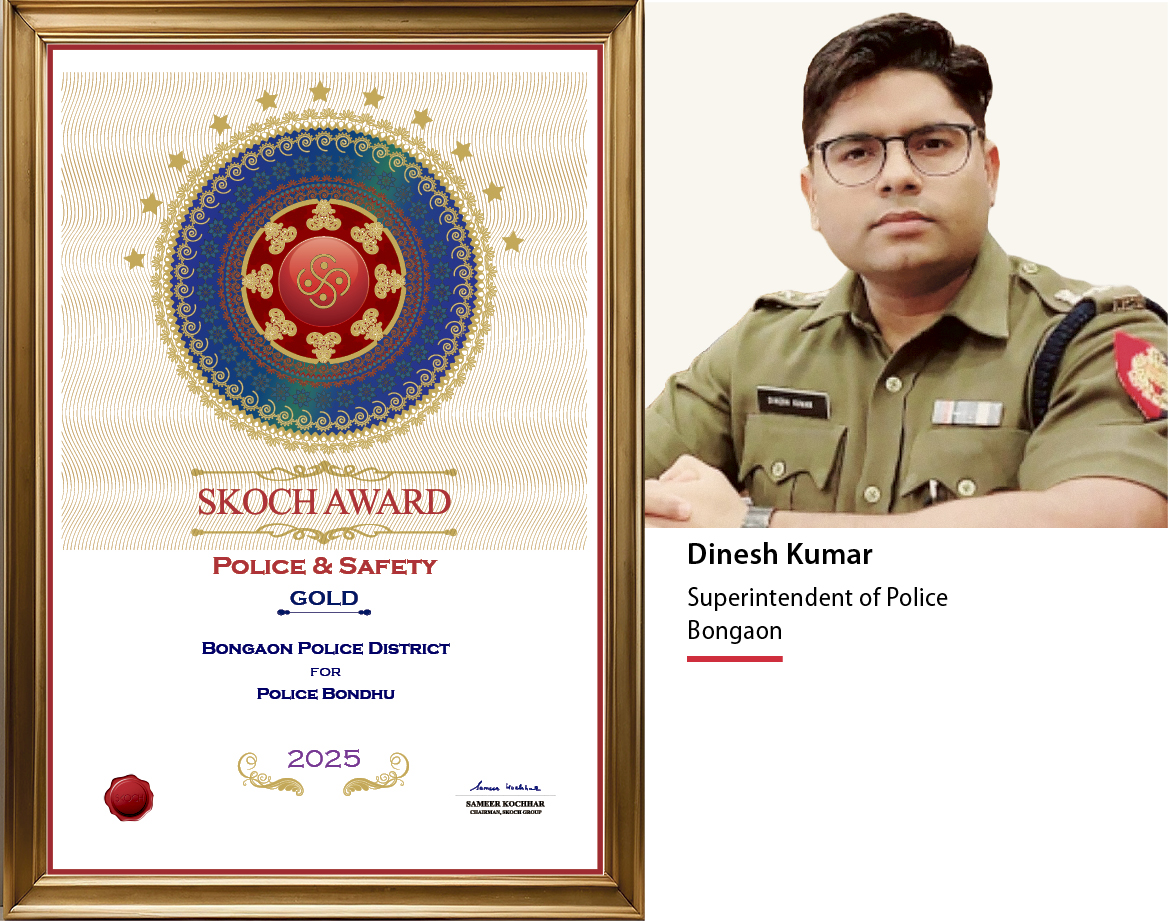
In Bongaon, a border district shaped by distance, migration and administrative load, the relationship between citizens and the police has long been defined by one persistent uncertainty: what happens after an FIR is filed? For most complainants, the filing marked not just the start of an investigation, but the end of information.
That uncertainty is now being systematically dismantled.
The change comes through Police Bondhu, an integrated district-level police management system that quietly redefines how investigations are tracked, supervised and experienced. Unlike headline-grabbing surveillance technologies, Police Bondhu focuses on something far more fundamental: visibility.
It allows citizens to log in using their mobile number and an OTP, see all FIRs registered in their name and access real time updates on the progress of each case. The system replaces repeated visits to police stations with a single, consistent source of truth.
What makes Police Bondhu distinctive is not that it digitises records, but that it repositions the complainant. For the first time, citizens can see the name and phone number of the investigating officer, track investigative steps such as visits and witness examinations, download the FIR copy and leave remarks that are formally recorded.
This simple feature alters the balance of power. The complainant is no longer a passive petitioner waiting for updates; they become an informed stakeholder in the process.
For police personnel, Police Bondhu creates a structured, role-based digital workflow. Every action taken by an investigating officer is logged. Every delay is visible. Dashboards allow supervisory officers from police station heads to senior district leadership to monitor investigations in real time.
This is not oversight driven by periodic inspections or paperwork, but continuous, data-led supervision. Accountability is no longer reactive. It is built into the system’s architecture.
Traditionally, information in policing moves slowly upward, often filtered through layers of reporting. Police Bondhu reverses this flow. Data from the grassroots reaches senior officers instantly, allowing patterns to emerge across police stations.
This enables better deployment of resources, faster intervention in stalled cases and informed decision-making at the district level. Policing becomes measurable, comparable and, therefore, improvable.
Implementing a digital platform in a district with large rural populations and uneven connectivity was never going to be straightforward. Many users had limited exposure to online systems. Internet access remained inconsistent in remote areas.
These challenges shaped the design. The platform was kept simple, mobile-friendly and multilingual. Awareness campaigns and handholding became part of implementation. Accessibility was treated not as an afterthought, but as a core requirement.
The measurable outcomes are clear. Automated workflows have reduced processing times. Transparency has increased citizen satisfaction. Supervisors have better visibility into the quality and pace of investigations.
But the deeper impact is cultural. Police Bondhu nudges policing away from personality-driven functioning toward process-driven professionalism. When actions are visible, behaviour changes. When timelines are known, urgency improves.
Police Bondhu does not pretend to be a perfect solution. Non-digital users still require offline support. Connectivity gaps persist. Some resistance to change remains.
Yet, its significance lies in proving that meaningful police reform does not require sweeping legislation or massive infrastructure. It can begin with a simple idea: that trust grows when the system itself is willing to be seen. In Bongaon, policing has taken a small but decisive step in that direction by becoming, in both name and practice, a Bondhu.
Perhaps the most understated innovation of Police Bondhu is that it treats public trust not as an abstract value, but as an operational outcome. By making every stage of investigation visible, the system replaces suspicion with information and patience with participation.
Beyond transparency and speed, Police Bondhu introduces an element rarely discussed in district policing: continuity. Investigations often suffer when officers are transferred or roles change. With a digital trail capturing actions, observations and timelines, cases retain coherence even as personnel rotate. New officers inherit context, not confusion. Over time, this accumulated data also becomes a learning resource, highlighting common delays, effective practices and systemic gaps. In doing so, the platform quietly transforms daily policing into a feedback-driven institution, capable of learning from its own history rather than repeating it.
Commissioned on 30 April 2024, the project has an annual generation potential of 58.1 million units with a capacity utilisation factor of 26.53 percent.
Solid waste management was among the most pressing issues. Years of unsegregated garbage posed health and environmental risks.
Affordable Housing by Private Developers on Private Land Uttarakhand Awas Evam Vikas Parishady
eASE App: Transforming Urban Governance Uttarakhand Housing and Urban Development Authority
"American roads are good not because America..
State Rankings Highlights -: Odisha scaled to number..
In the run-up to the elections, the most..
Step 1: Call for Project Submission Call for..

Inclusion is the first magazine dedicated to exploring issues at the intersection of development agendas and digital, financial and social inclusion. The magazine makes complex policy analyses accessible for a diverse audience of policymakers, administrators, civil society and academicians. Grassroots-focused, outcome-oriented analysis is the cornerstone of the work done at Inclusion.