Education and welfare are inseparable in Andhra Pradesh. For millions of students from Scheduled Castes, Scheduled Tribes, Backward Classes, minority communities, economically weaker sections and differently abled backgrounds, access to education depends heavily on the state’s ability to support them.
At the center is the Social Welfare Department in Tadepalli, Guntur district. It manages one of the largest welfare-linked education networks, covering over 8,000 colleges, 62 universities and 33 stakeholder departments. Annually, it serves 38 lakh beneficiaries and disburses nearly Rs 7,329 crore in scholarships.
Despite its scale, the system once struggled with its own complexity. Before 2017, departments awarded scholarships largely through manual processes: students submitted applications in person, navigated multiple offices and verification steps and staff duplicated data entry, resulting in fragmented information. These practices caused delays, errors and uncertainty in timelines.
Students found the process lacked transparency, they could not track application status or payment schedules. Administrators struggled to manage vast datasets without effective monitoring tools. The system simply could not keep pace with its scale.
By 2016, it was clear that incremental improvements would not resolve systemic inefficiencies. Responding to these persistent challenges, the Government of Andhra Pradesh decided to redesign the system entirely by creating a unified digital platform.
The goal went beyond digitisation to transformation bringing students, institutions, departments and financial systems onto a single integrated framework. The vision emphasises transparency, accountability and efficiency, while ensuring access for marginalised groups.
In 2017, JnanaBhumi brought this vision to life.
JnanaBhumi is a flagship platform that provides a single window for education-related services. It manages the entire scholarship lifecycle, from registration and eligibility verification to sanction and Direct Benefit Transfer (DBT).
Students apply online for scholarships, fee reimbursement, overseas education support and skill development programmes. The platform pays tuition fees directly to institutions and transfers maintenance allowances to students, reducing reliance on intermediaries.
The system achieved a major breakthrough in transparency. Students now track applications in real time and receive updates through SMS, email and messaging platforms.
JnanaBhumi integrates over 18 government databases, including income, social status and household data. Aadhaar-based authentication ensures accurate identification, while links to revenue, civil supplies and transport databases support real-time validation.
The platform instantly verifies applications, removing the need for physical paperwork. Automated workflows, applicant sign-up, data checking, document review and decision-making, have drastically reduced processing time. Processes that once took weeks now take days and the state’s financial management system directly disburses funds.
JnanaBhumi streamlined scholarships, but gaps remained in hostel management. Welfare hostels, housing thousands of students, still relied on manual systems for attendance, health tracking and resource management.
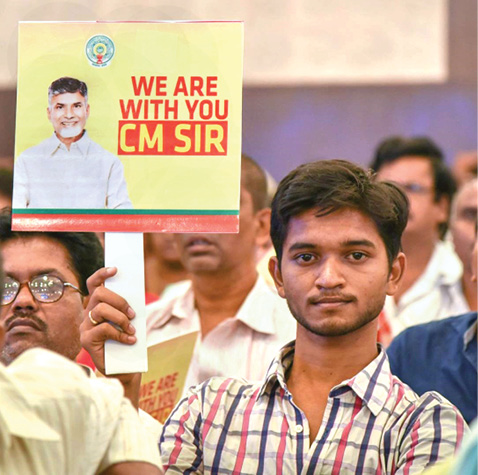
Launched in 2017, JnanaBhumi enables seamless delivery and monitoring of scholarships, educational benefits and hostel administration. By enhancing transparency, accountability and efficiency, the platform has increased access to timely scholarship disbursement and improved student support
To address this, the government introduced NIVAS, a complementary digital platform. NIVAS integrates hostel operations into a single system, covering admissions, biometric attendance (electronic recording of presence using fingerprints or facial recognition), academic tracking (monitoring student progress and performance), health monitoring (tracking residents’ health status) and diet planning through the Annapurna module (a feature for managing and planning residents’ meals).
Biometric attendance ensures accuracy, while dashboards allow real-time monitoring by district and state officials. Automated systems manage diet allocation, stock and vendor payments, improving efficiency and oversight.
Together, JnanaBhumi and NIVAS create a unified welfare ecosystem that connects education, nutrition, health and administration.
Achieving such a large-scale transformation required strong coordination among stakeholders. Multiple departments, institutions and field-level staff had to align their processes and adopt new systems, underscoring the scale of collaboration needed.
JnanaBhumi’s success depended on breaking departmental silos and enabling collaborative governance. This shift from isolated functioning to integrated operations was central to the reform.
The transition to digital systems proved complex. Integrating multiple departments with legacy processes required extensive consultation and restructuring.
Digital literacy was a challenge. Many users needed training and support for the new platforms. Infrastructure gaps, especially in remote areas, also affected access and connectivity. To overcome these barriers, the government adopted a multi-layered approach. Statewide training programmes supported by helpdesks and user assistance systems reached users. Mobile-friendly and multilingual interfaces improved accessibility.
Technical safeguards such as Aadhaar authentication, biometric systems and validation tools (methods to confirm identity and data accuracy) ensured data accuracy and prevented duplication. Cloud infrastructure enhanced scalability, enabling the system to handle large volumes efficiently. Over time, adoption increased and performance stabilised.
The SKOCH State of Governance Report 2025 places Andhra Pradesh at #1 nationally – for the third time. What stands out instead is the breadth of performance, the depth of recovery in difficult sectors and the consistency with which governance outcomes are being delivered. Eighty-seven well-performing projects this year qualified for deeper study.
This is not the story of a single reform or a headline-grabbing scheme. It is the story of how governance, in Andhra Pradesh, has increasingly become institutionalised.
The state leads the country in District Governance and Municipal Governance, reflecting a model where decision-making, monitoring and service delivery are actively pushed closer to citizens. This decentralised emphasis is visible in the volume and quality of initiatives emerging from district administrations and urban local bodies.
Andhra Pradesh’s leadership in e-Governance is not defined by isolated digital platforms but by how technology has been woven into everyday administration. Across departments, digital tools are being used to track service delivery, manage beneficiary databases, monitor project progress and reduce discretion at the cutting edge. This has had a cascading effect – improving transparency, shortening response times and enabling data-backed decision-making.
Few sectors reflect the complexity of governance more than Police & Safety. It is a domain shaped
by public trust, operational readiness and institutional culture. Andhra Pradesh’s strong performance in policing reflects sustained improvements across multiple dimensions: adoption of technology-enabled policing tools, improved emergency response mechanisms, enhanced surveillance and communication systems and better coordination between field units and command centres.
Energy governance is often a stress test for state capacity. Financial pressures, infrastructure demands and regulatory complexity make sustained performance difficult.
Andhra Pradesh stands out for maintaining top-tier performance in Power & Energy over multiple years. Operational improvements – such as tighter billing systems, reduction of technical losses and technology-driven monitoring – have strengthened the sector’s institutional foundations. Consistency in this sector points to governance maturity: systems that hold even when conditions are challenging.
In Sanitation, the state’s leadership reflects coordinated action at the municipal and community levels. Environmental governance, meanwhile, has benefited from structured planning and enforcement mechanisms. Monitoring systems, regulatory compliance and inter-departmental coordination have helped maintain consistent performance in a sector where results are typically uneven. Together, these sectors reveal a governance philosophy that looks beyond asset creation to outcome durability.
Some of the most telling achievements of Andhra Pradesh lie in sectors that demanded recovery rather than maintenance.
In Revenue, improved administrative processes and tighter monitoring have helped the state regain strong national standing. Digitisation, data integration and improved compliance mechanisms have strengthened fiscal administration.
Rural Development and Social Justice & Security reflect a similar trajectory. Governance systems in these sectors have focused on better targeting, streamlined delivery and improved coordination.
Agriculture governance has focused on service delivery mechanisms that support farmers through timely interventions and institutional coordination. In Health, the emphasis is on systems, monitoring, access and administrative coordination.
Horticulture stands out for consistency. Sustained performance here reflects long-term planning and stable institutional support, rather than short-term interventions.
The impact of JnanaBhumi and NIVAS is evident in improved outcomes. Scholarship processing times have been significantly reduced, ensuring timely disbursement. Financial transactions are fully digital, enhancing transparency and accountability.
The system eliminated duplicate beneficiaries, creating leak-proof processes. Attendance-linked services improved accountability and hostel management is now more efficient with real-time monitoring.
Students experience tangible benefits: simplified applications, real-time tracking and direct fund transfers. Administrators gain visibility and control, which strengthen trust in welfare delivery.
These platforms have enabled a major shift in governance by using data. Policymakers now access real-time data on attendance, fund utilisation, health and performance to guide decisions. This data-driven approach allows targeted interventions, better resource allocation and continuous policy refinement. By using real-time insights, governance shifts from reactive to proactive, which improves overall programme effectiveness.
JnanaBhumi and NIVAS support growth through a modular architecture that allows new government programmes to be added without disrupting existing systems. Their cloud infrastructure refers to servers and services delivered over the internet, which increases reliability and performance.
Already deployed across thousands of institutions, the system offers a replicable model for other sectors and regions. It aligns with broader national initiatives, such as Digital India and offers key lessons in digital transformation.
These include the importance of process re-engineering before digitisation, stakeholder engagement, user-centric design and continuous training. The platforms also highlight the critical role of data integrity and inclusive access in building effective digital systems.
JnanaBhumi and NIVAS have had their greatest impact at the last mile. By linking identity, eligibility, attendance and financial systems into a single digital chain, they have reduced the gap between policy and beneficiary.
Direct Benefit Transfer has been transformative, ensuring funds reach verified accounts without intermediaries. For families, this brings financial certainty; for students, it ensures uninterrupted education without delay.
Greater transparency has improved accountability. Real-time dashboards, audit trails and automated alerts make every stage visible. Institutions and administrators take more responsibility, while students track and question delays with evidence. Beyond efficiency, the platforms have a broader social impact. They contribute to higher retention rates, improved academic continuity and greater confidence among marginalised communities. They demonstrate that governance can be responsive, predictable and fair.
"American roads are good not because America..
State Rankings Highlights -: Odisha scaled to number..
In the run-up to the elections, the most..
Step 1: Call for Project Submission Call for..

Inclusion is the first magazine dedicated to exploring issues at the intersection of development agendas and digital, financial and social inclusion. The magazine makes complex policy analyses accessible for a diverse audience of policymakers, administrators, civil society and academicians. Grassroots-focused, outcome-oriented analysis is the cornerstone of the work done at Inclusion.