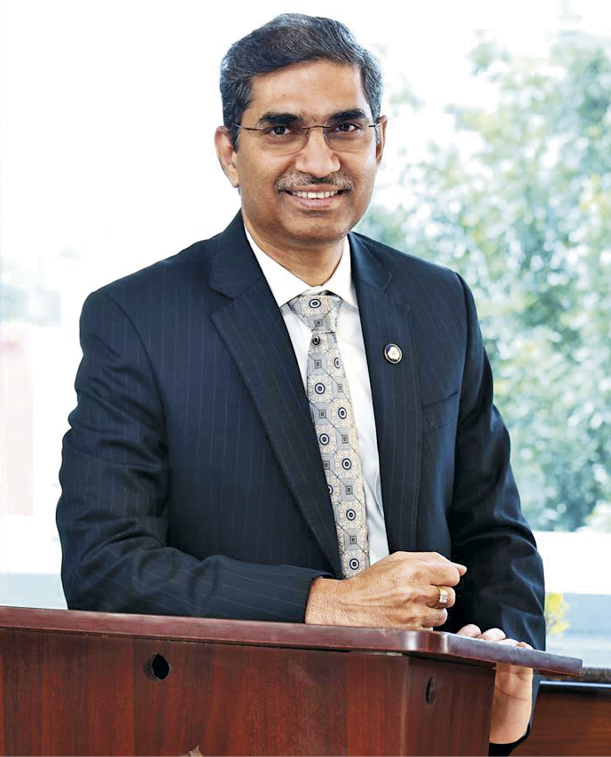
By Binod Kumar, Managing Director & CEO, Indian Bank
Indian Bank perceives financial inclusion as more than an initiative, it is a meaningful opportunity to engage with the most remote and underserved sections of society. This conviction is anchored in our firm belief that an inclusive financial system is the cornerstone of a resilient and sustainable economy.
Among the Bank’s many initiatives, IB SAATHI – Indian Bank’s Sustainable Access and Aligning Technology for Holistic Inclusion stands out as a flagship achievement of the Financial Inclusion Department. It is truly a jewel in the crown, enabling seamless end-to-end digital Business Correspondent (BC) lifecycle management. The platform facilitates easy onboarding, simplifies record-keeping and streamlines follow-up processes, ensuring a smooth and efficient digital journey for our BC partners.
With the advent of IB SAATHI, the Bank has witnessed a significant expansion in its BC network, extending the financial arm of Indian Bank deep into unserved and underserved regions. This digitally enabled outreach has made it possible to serve even the most difficult, peripheral and far-flung regions across the country, thereby ensuring last-mile connectivity.
These eff orts have translated into tangible outcomes, particularly in the key social security schemes such as PMJDY, PMJJBY, PMSBY and APY, enabling the Bank to consistently achieve its targets year after year.
During the financial year 2025-26, Indian Bank’s sustained and focused efforts in the Atal Pension Yojana (APY) have received widespread recognition. The Bank was conferred the APL Excellence Cup in the APY Premier League, the APY Visionary Trendsetter Award under the APY Trendsetters Campaign and the Par Excellence Leadership Award in the APY Leadership Pinnacle
Campaign.
The SKOCH Gold Award for this IB SAATHI initiative now is yet another feather in the cap to Indian Bank’s commitment to financial inclusion over its illustrious 118-year journey of service to the nation.
In an era of evolving cyber threats, it is imperative to consistently strengthen our technology, processes and security frameworks. From core banking systems to digital channels, applications and customer data, comprehensive protection is ensured through round-the-clock automated surveillance and proactive risk management, supported by the Bank’s robust and resilient security infrastructure.
The SKOCH Silver Award conferred on the Bank for this initiative stands as a testament to our unwavering commitment to trust, reliability and the highest standards of security for our esteemed customers.
We remain confident that every step taken by Indian Bank brings the nation closer to the vision of Viksit Bharat, while strengthening and sustaining the country’s economic resilience.

In the popular imagination, financial inclusion is a physical story. It is a counter in a village, a biometric scanner, a customer who no longer has to lose a day’s wage to reach a branch. Cybersecurity, by contrast, is invisible, an upstairs room of screens and alerts that most customers will never see.
Indian Bank’s recent transformation rests on a quieter but more demanding proposition: these are not separate stories. Scale without trust is fragile and trust without scale is incomplete. In two parallel initiatives, IB SAATHI for last-mile service delivery and a strategic transformation of its Security Operations Centre, the bank is attempting to build a system that can both reach the underserved and defend itself in an age of relentless digital risk.
What emerges is not a tale of technology for its own sake, but of institutional maturity: a public sector bank recognising that inclusion and resilience must grow together.
For Indian Bank, the challenge of financial inclusion has always been concrete. Vast geographies, dispersed populations and limited physical infrastructure stretch the branch-led model. The Business Correspondent (BC) channel offered a practical bridge but one that came with its own vulnerabilities.
BCs were often managed through fragmented processes. Onboarding varied across regions. Training depended on local capacity. Performance monitoring was uneven. Remuneration, critical for sustainability, was not always transparent or timely. Over time, it became clear that inclusion would stall without a disciplined, end-to-end framework.
IB SAATHI (Sustainable Access and Aligning Technology for Holistic Inclusion) was conceived as that framework. Designed as a comprehensive digital backbone, it manages the entire BC lifecycle: onboarding, due diligence, re-KYC, ongoing performance oversight and deboarding. The goal was not simply to expand reach, but to professionalise the last mile.
Before IB SAATHI, much of the BC ecosystem depended on manual records and localised practices. Migrating this legacy data into a regulated digital environment posed challenges around data quality and standardisation. Yet the bank persisted, recognising that scale without structure would only replicate inefficiency.
IB SAATHI began as a digital onboarding application. Over time, it evolved into an extended arm of the bank. Today, BC outlets operating on the platform offer more than 60 banking services, from AEPS and SHG transactions to social security scheme enrolments, lead generation for deposits and loans, insurance products and term deposits.
What distinguishes IB SAATHI is not just service expansion, but operational discipline. Every activity leaves a digital trail. Performance is tracked through robust MIS dashboards accessible across branches, zones and the corporate office.
BCs are no longer informal intermediaries, but frontline banking facilitators embedded in a regulated system. Learning Management Systems address the need for continuous upskilling as products, regulations and customer expectations evolve. Grievances are managed through ticketing mechanisms rather than ad-hoc escalation. Location management tools provide visibility without micromanagement.
The outcomes are tangible. Access to banking services has expanded significantly in underserved and rural areas. Service delivery has improved through proximity and defined service windows. The banking network has strengthened—not just by widening reach, but by aligning technology with customer needs and operational accountability.
More than a platform, IB SAATHI has become a system of record for last-mile banking. But as the bank’s digital footprint expanded outward, another challenge sharpened inward.
Inside Indian Bank’s Security Operations Centre (SOC), pressure was mounting. Analysts faced a flood of alerts, many lacking context or prioritisation. Investigations required constant switching between SIEM dashboards, ticketing systems, emails and manual checks. Incident handling varied across analysts and shifts. Responses were often reactive, driven by external advisories rather than internal intelligence.
In a financial institution, these are not minor inefficiencies. Delays can translate into financial loss, reputational damage and erosion of trust. The bank recognised that cybersecurity could no longer rely on incremental fixes. It required a structural rethink.
The response was a strategic transformation built around a security orchestration framework. Rather than replacing existing tools, the bank unified them. SIEM systems, endpoint protection tools, perimeter security devices, identity management and multiple threat intelligence feeds were integrated into a single investigative and response environment.
Automation became central. Repetitive actions blocking suspicious IPs, hashes, domains and URLs were converted into playbooks. Systems exhibiting malware or ransomware behaviour could be isolated from the network and restored after remediation. User details could be pulled directly from identity systems to enrich investigations.
Equally important was standardisation. Automated workflows defined consistent incident-handling phases cross teams and shifts. What had earlier depended on individual judgment now followed institutional logic. Continuity improved. Errors reduced. Response times shortened.
The most consequential shift was philosophical. The SOC moved from reacting to alerts to actively hunting threats. The orchestration platform continuously ingests global threat intelligence feeds, collecting Indicators of Compromise and adversary techniques. Event logs are scanned proactively, enabling early detection of emerging threats.
Regulatory alignment is embedded directly into operations. Advisory inputs from bodies such as RBI CSITE, CERT-In and the National Critical Information Infrastructure Protection Centre are automatically ingested and acted upon. Compliance, in this model, is not an external audit exercise but a living part of daily defence.
The outcomes mirror the ambition. Incident response actions are automated. A uniform response process governs SOC operations. Analysts are freed from repetitive manual tasks and can focus on higher-value threat analysis. Digital trust is strengthened at the core even as services scale at the edge.
What makes these twin transformations noteworthy is the institutional context. Public sector banks operate at scale, under scrutiny, across diverse geographies and legacy systems. Any reform must work not just in ideal conditions, but in everyday complexity.
IB SAATHI strengthens the human interface rather than bypassing it. The SOC transformation restores control rather than showcasing novelty. Together, they suggest a recalibration of priorities: investing not in one-off innovations, but in institutional muscle memory systems that enforce consistency, remember decisions and learn over time.
Taken together, these initiatives outline what mature inclusion now looks like. It is not simply the multiplication of access points, but the professionalisation of the systems behind them: training, monitoring, grievance redressal and payment transparency at the edge; standardised incident handling, automation and regulator-aligned response at the core.
In Indian Bank’s telling, inclusion and security are no longer parallel tracks. They are mutually dependent pillars of modern public banking, redefining what it means to serve at scale, responsibly.
“India’s growth constraint is increasingly a savings and efficiency problem, not a reform deficit,” said Sameer Kochhar, Chairman, SKOCH Group. “Without a durable expansion of domestic savings, especially long-term savings,...
Democracy has ensured that citizens participate in governance, hold institutions accountable and shape the country’s destiny through their collective voice. Federalism, on the other hand, has allowed governance to adapt...
India’s revenue effort over the past four decades reveals both progress and challenges. The tax-to-GDP ratio has improved from less than 14 percent in the early 1980s to about 18.5...
The independence achieved after long struggle carries deep meaning that must be preserved with equal determination. Passing this message to younger generations, particularly students and future leaders, becomes crucial.
"American roads are good not because America..
State Rankings Highlights -: Odisha scaled to number..
In the run-up to the elections, the most..
Step 1: Call for Project Submission Call for..

Inclusion is the first magazine dedicated to exploring issues at the intersection of development agendas and digital, financial and social inclusion. The magazine makes complex policy analyses accessible for a diverse audience of policymakers, administrators, civil society and academicians. Grassroots-focused, outcome-oriented analysis is the cornerstone of the work done at Inclusion.