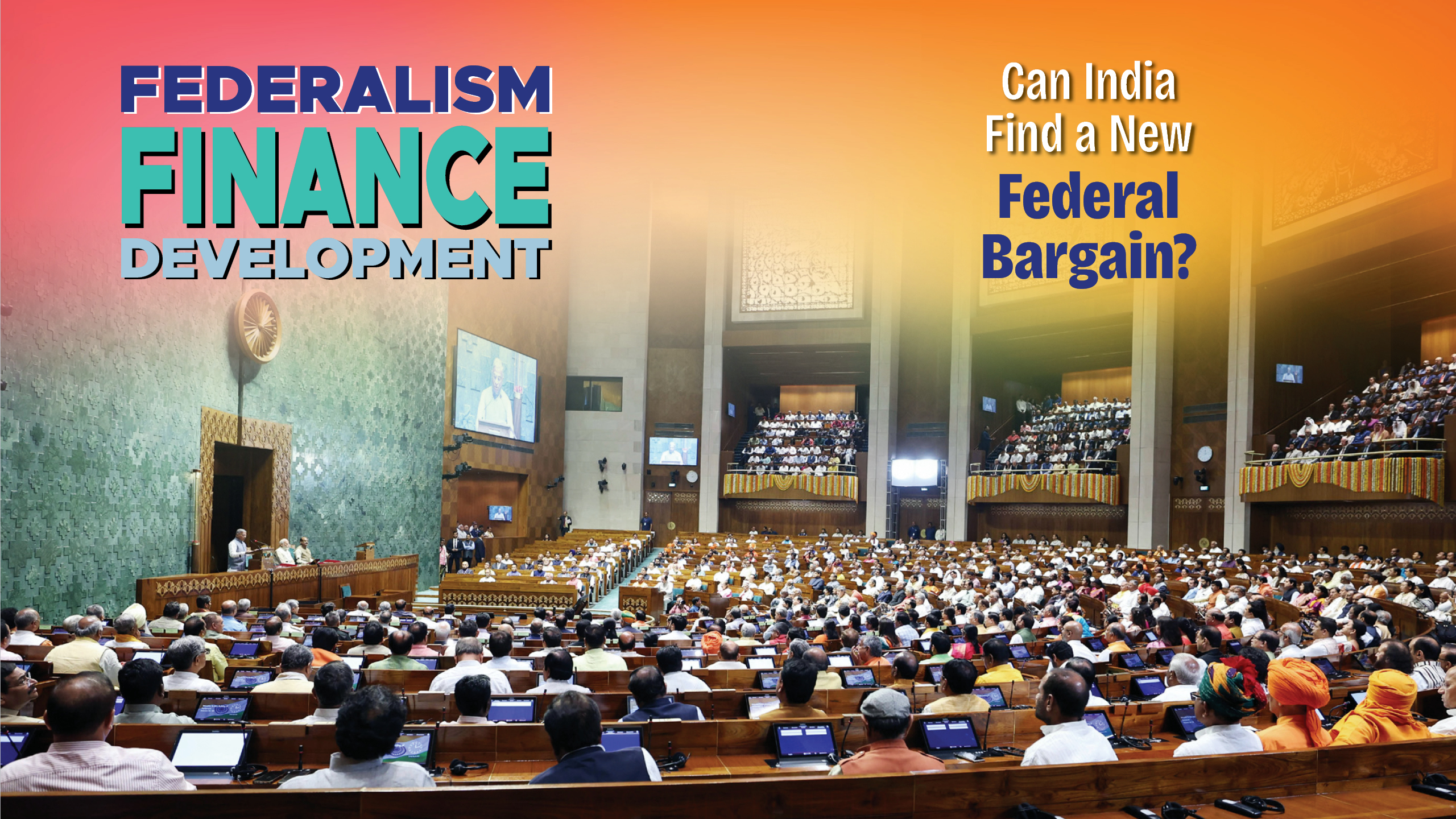
India’s growth story has always been a federal story. Railways and roads may be budgeted in Delhi, but the last mile is stitched together in Lucknow, Chennai, Imphal and Srinagar. The Centre frames GST rules; states administer them. New schemes arrive with a flourish; their outcomes depend on district collectors and panchayat secretaries. When the Centre–state compact is healthy, India hums. When it frays, reform slows, deficits widen and trust thins.
Right now, that compact is under stress and yet, also on the cusp of renewal. Tax reform is entering a second act, a new Finance Commission has been tasked with recalibrating the fiscal architecture and India’s trading environment is being reshaped by tariffs and, even more, by non-tariff measures abroad.
This feature maps the fault lines, the fresh opportunities and a constructive path to a new cooperative federalism that can finance development and carry India’s voice as a credible leader of the Global South.
A study by the Reserve Bank of India’s on budgets (2024-25) captures the broad macro reality: a post-pandemic rebound in revenues, but uneven fiscal health and sticky debt ratios across states.
The latest edition collates budgeted and actual data and sets out the challenges: containing committed expenditures (pensions, interest), improving public investment quality and safeguarding fiscal consolidation through buoyant own-tax revenues and predictable transfers.
The political economy has become sharper. Several states are straining under expanding welfare promises and subdued own-tax growth; audits have flagged gaps.
The political economy has become sharper. Several states are straining under expanding welfare promises and subdued own-tax growth; audits have flagged gaps. In Rajasthan, for instance, the fiscal deficit widened amid rising subsidy commitments, underscoring the tension between short-term welfare and long-term sustainability.
At the same time, states’ fiscal space is heavily shaped by national tax devolution and centrally sponsored schemes. The Fifteenth Finance Commission (15th FC) fixed the states’ share of central taxes at 41% for 2021-26 (down from the Fourteenth Finance Commission’s 42% after the carve-out for the erstwhile state of Jammu & Kashmir). The Sixteenth Finance Commission (16th FC), chaired by Arvind Panagariya, now has the harder job: reconciling Centre–state claims after the end of GST compensation, against elevated debt and a development agenda from urban infrastructure to climate adaptation that demands more from every rupee.
Economists have long flagged the tension between reform ambition and state autonomy. Vijay Kelkar, veteran public finance scholar and former chair of the Thirteenth Finance Commission, has praised GST’s efficiency gains while cautioning that its design can centralise fiscal control at the cost of state autonomy unless checks and balances are maintained.
The Centre–state truce that enabled the Goods and Services Tax (GST) in 2017 rested on three pillars: a single market, a guaranteed five-year compensation window to offset shortfalls and a promise to continually improve the system. The first two were delivered; the third is now urgent.
Substantively, the 56th Council endorsed a rate structure simplification towards two main rates (a standard 18% and a merit 5%) with a de-merit 40% for a small set of goods, phased implementation timelines and significant relief on individual health and life insurance (GST exempt) and lifesaving drugs (reduced or nil rates). It also moved to operationalise the GST Appellate Tribunal (GSTAT) with clear dates for accepting and hearing appeals, finally restoring the dispute-resolution backbone that GST lacked.
From the launch of GST, there was unusual political unity. As one analyst noted, in a rare moment of federal cooperation, states cutting across party lines supported the Centre’s move on GST. Yet scholarship has consistently warned about design risks. The introduction of GST has substantially shifted the balance of fiscal powers between the Central and State governments, raising new questions about fiscal autonomy.
In the run-up to the 2025 package, Prime Minister Narendra Modi reiterated the cooperative frame: when the Centre and states move forward together, the dream of a self-reliant India will be fulfilled, every state will develop and India will become a developed nation. And Piyush Goyal, Union Commerce Minister, has repeatedly underscored the competitive-collaborative ethos saying that the government believes in competitive, collaborative and cooperative federalism.
In the run-up to the 2025 package, Prime Minister Narendra Modi reiterated the cooperative frame: when the Centre and states move forward together, the dream of a self-reliant India will be fulfilled.
Economists are clear that execution is everything. They say that despite improved buoyancy, revenue risks persist for several states beyond the compensation period and many have not yet reached the SGST shares envisioned at launch.
Sanjeev Sanyal, member of the EAC-PM, has stressed that the September 2025 rate changes aim to enhance economic efficiency by simplifying the tax system, adding that public pressure must ensure businesses pass benefits to consumers.
The constructive takeaway: the Council’s 2025 package can be the long-awaited “GST 2.0”, if the two-rate vision is executed with credible timing, GSTAT delivers uniform jurisprudence and data-driven refunds/credits reduce friction for MSMEs. Done well, this broadens the base and stabilises SGST flows more sustainably than reviving compensation.
The Prime Minister has repeatedly framed India’s development as a shared enterprise saying that cooperative federalism is the way forward to ensure development of the nation. During the NITI Aayog Governing Council (2022), he emphasised the states’ role in the pandemic where Every State played a crucial role according to its strength and contributed to India’s fight against Covid.
India’s federal structure and cooperative federalism emerged as a model for the world during the Covid crisis. He has also contrasted this vision with coercion, saying co-operative and not coercive federalism must be the norm in our country. The states must coordinate with the Union Government and not remain subservient.
In practice, the compact requires three things:
Institutionally, there are signs of maturation. At the 25th Central Zonal Council (2025), Madhya Pradesh CM Mohan Yadav argued, the notion that states and the Centre are rivals has changed now, we are partners. Institutional platforms like NITI Aayog, Chief Ministers’ Council and Zonal Councils have evolved into platforms for solutions. Uttar Pradesh CM Yogi Adityanath described the meet as concretising cooperative and competitive federalism in action.
That language matters; cooperation becomes less rhetorical when anchored in councils, budgets and deadlines.
India’s trade policy is shifting terrain. Traditional tariff skirmishes are one front; more pervasive are non-tariff measures (NTMs) — standards, certifications, sustainability rules (e.g., carbon border adjustments) and sanitary/phytosanitary norms.
The Economic Advisory Council to the PM has documented the NTB web facing exporters in key markets. Independent assessments (e.g., Council on Energy, Environment and Water) flag the need for upgraded compliance systems across value chains. Policymakers are responding: the Commerce Ministry has indicated creation of a portal to track and resolve Non-Tariff Barriers to Trade (NTB), Sanitary and Phytosanitary measures (SPS) and Technical Barriers to Trade (TBT) issues; if executed well, a nervous system for trade diplomacy and standards would have been created.
Policymakers are responding: the Commerce Ministry has indicated creation of a portal to track and resolve NTB, SPS and TBT issues. If executed well, a nervous system for trade diplomacy and standards would have been created.
Why this matters for federalism: Export competitiveness is local. Standards compliance requires state-level labs, logistics, cold chains and skilling. When NTMs choke shipments from Tuticorin or Morbi, SGST revenue and jobs in Tamil Nadu or Gujarat suffer.
A Centre–state compact on trade facilitation — from port connectivity and warehousing to conformity assessment infrastructure — lifts both exports and state finances.
The challenge: Several states worry SGST buoyancy won’t replace the compensation cushion; NIPFP and state budgets suggest uneven outcomes, with high-welfare and producing states feeling the pinch.
What to do
Zonal Council meetings can be described as concretising cooperative and competitive federalism.
The challenge: Cash-flow volatility for states, especially smaller ones, in devolution releases and CSS reimbursements undermines capex planning.
What to do
The challenge: Populist cycles and off-budget liabilities create moral hazard; audits highlight mounting subsidies with limited growth multipliers.
What to do
The challenge: India’s growth hinge is urban infrastructure, but municipal finance is anaemic; states shoulder the load without buoyant property taxes or user charges.
What to do
The challenge: NTMs, from traceability to carbon content, are becoming binding constraints, throttling shipments and deterring investment in export ecosystems.
What to do
While exemptions can be rationalised, revenue adequacy must remain the guardrail. For MSMEs, compliance relief through standardised e-invoicing thresholds and streamlined return corrections can reduce friction and widen the base.

Education and welfare are inseparable in Andhra Pradesh. For millions of students from Scheduled Castes, Scheduled Tribes, Backward Classes, minority communities, economically weaker sections and differently abled backgrounds, access to...
"American roads are good not because America..
State Rankings Highlights -: Odisha scaled to number..
In the run-up to the elections, the most..
Step 1: Call for Project Submission Call for..

Inclusion is the first magazine dedicated to exploring issues at the intersection of development agendas and digital, financial and social inclusion. The magazine makes complex policy analyses accessible for a diverse audience of policymakers, administrators, civil society and academicians. Grassroots-focused, outcome-oriented analysis is the cornerstone of the work done at Inclusion.