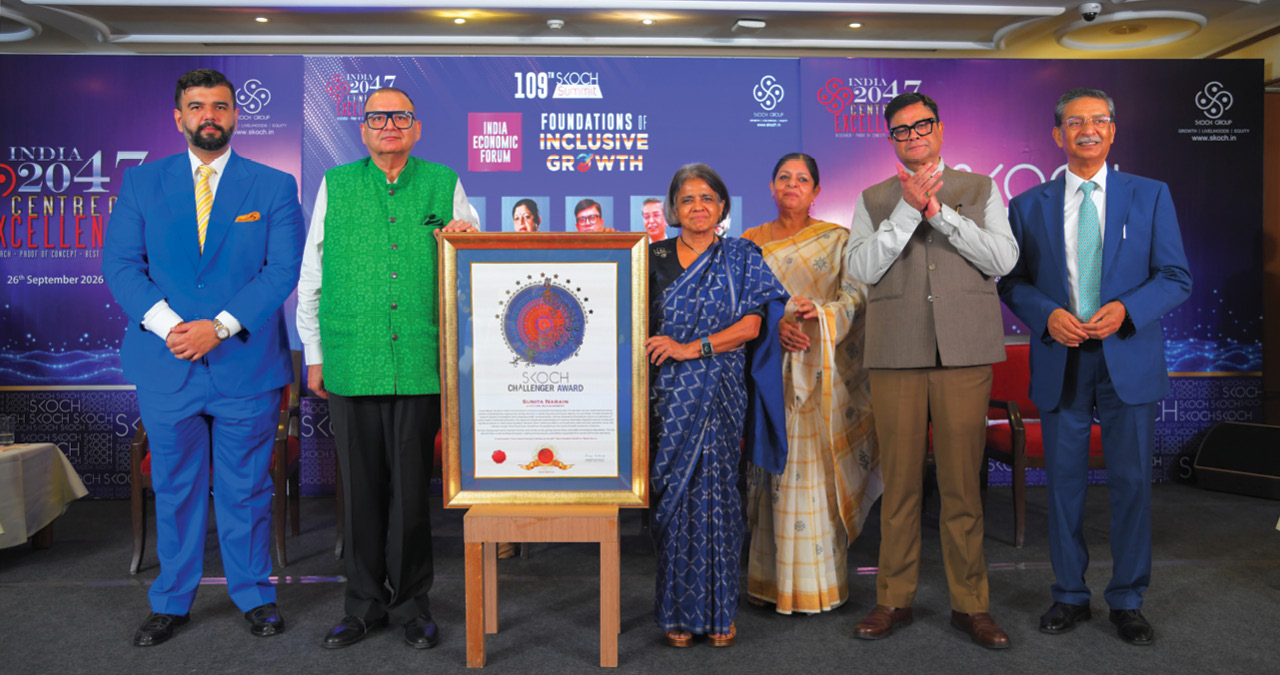
The conferment of the SKOCH Challenger Lifetime Achievement Award on Sunita Narain was more than a recognition of an environmentalist. For those reflecting on her journey at the 109th SKOCH Summit, it acknowledged a body of work that has changed how India discusses the environment, development and equity.
Poonam Mutreja, who has known Narain for decades, identified her strength as an unusual blend of clarity and courage. Narain, she said, can cut through a problem and uncover “the questions that lie beneath” it. Under her leadership, the Centre for Science and Environment (CSE) and Down To Earth have not only chronicled the environmental change; they have also supported problems and solutions with evidence. For Mutreja, the greater significance of Narain’s work lies in
its humanism.
Environmentalism, is not just about protecting nature. It is about equity, health and ultimately, justice. Narain’s insistence on bringing humanity into science, while remaining grounded in people’s lived realities, explains why her work goes beyond conventional environmental advocacy.
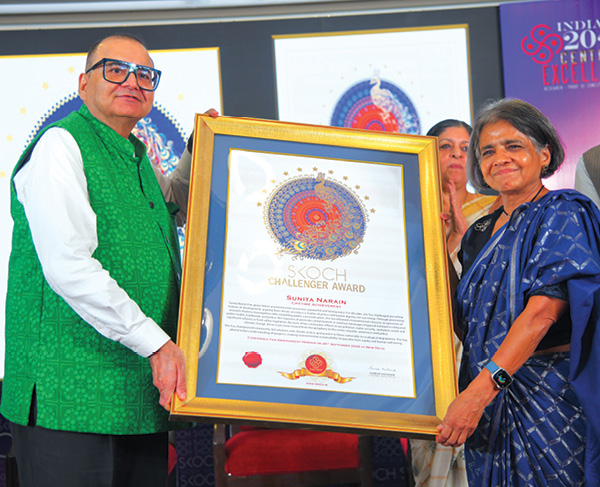
Sunita Narain has given India’s environmental conscience a powerful voice, making sustainability inseparable from equity and human dignity. Through research, investigation and public advocacy, she has brought air pollution, water, sanitation, waste, food safety and climate justice into mainstream policy. Her enduring contribution is redefining development around public health, livelihoods, accountability and environmental justice.
Sanjay Kumar offered another measure of her influence. Recalling the environmental discourse, he said discussions on the environment seemed incomplete without Narain’s name. What distinguished her contribution was the attention to detail and research she brought to it. His call for more evidence in policymaking echoed the approach he credited her with bringing environmental debate on the national agenda. India, he argued, needs more leaders capable of imagining connections and bringing disparate concerns together.
Bharat Lal widened the frame further. Honouring Narain, he said, meant honouring “a certain idea” and a body of work that touched many lives. At a time when the environment was hardly fashionable, she devoted her life to air, water, forests and public health. Today, the society has entered a “period of consequences,” evident in water scarcity, polluted air and natural disasters.
The real tribute would be to translate decades of advocacy into outcomes – cleaner air, better sanitation and safe drinking water, especially for the poorest, who bear the highest cost of environmental failure.
India intends to become a USD 30 trillion economy by 2047. Reaching that mark from a base of roughly USD 3.96 trillion implies sustained nominal growth near 9.6 percent in...
There are three goals for 2047. One is to become a developed nation, second is inclusiveness in terms of employment, human development to everyone so that inequalities can be reduced....
Regulatory reform is usually assessed through familiar questions, i.e., how many approvals are required? How many compliances must a business undertake? How quickly can permissions be granted? How efficiently can...
Regulatory frameworks rarely make headlines, yet they increasingly determine whether nations succeed or fall behind. The vision of Viksit Bharat represents one of India’s most important national aspirations. By 2047,...
When 22-year-old Anjali from a Scheduled Caste family in Kerala completed her education, she found herself facing a familiar dilemma. Like thousands of young people from disadvantaged communities, she had...
"American roads are good not because America..
State Rankings Highlights -: Odisha scaled to number..
Step 1: Call for Project Submission Call for..
In the run-up to the elections, the most..

Inclusion is the first magazine dedicated to exploring issues at the intersection of development agendas and digital, financial and social inclusion. The magazine makes complex policy analyses accessible for a diverse audience of policymakers, administrators, civil society and academicians. Grassroots-focused, outcome-oriented analysis is the cornerstone of the work done at Inclusion.