Over the past decade, Bihar’s governance trajectory has been one of gradual strengthening punctuated by sectoral breakthroughs. While rankings have fluctuated year to year, the broader arc from 2014 to 2025 reflects a state steadily reinforcing its institutional foundations.
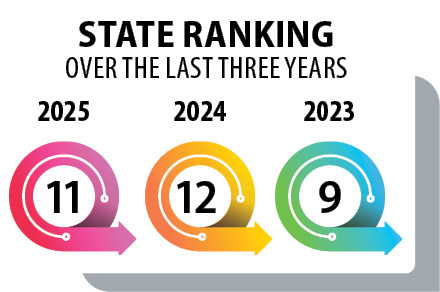
In the SKOCH State of Governance Report 2025, Bihar ranks #11 nationally, just outside the top ten but with visible momentum across multiple high-impact sectors. A total of 12 well-performing projects qualified this year for deeper study.
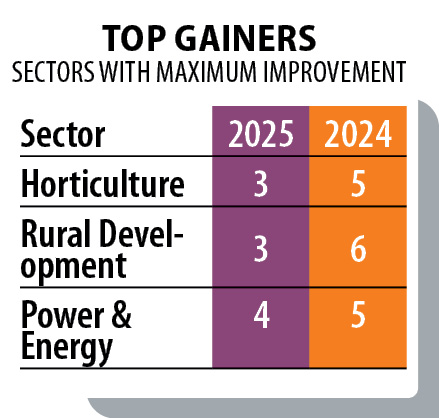
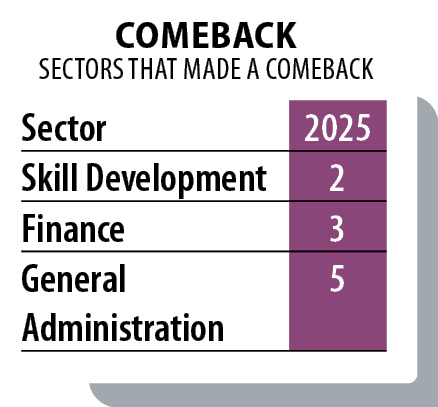
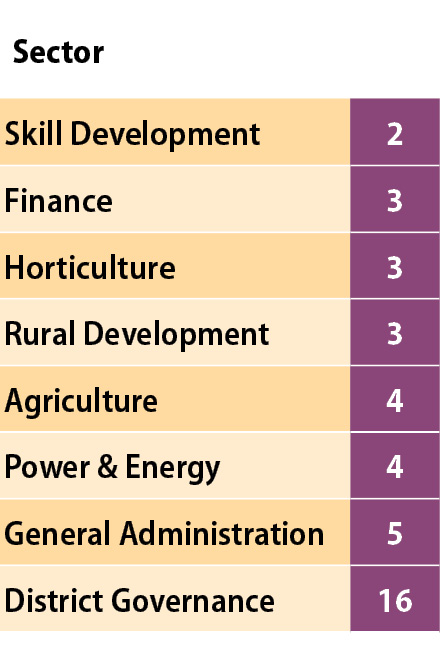
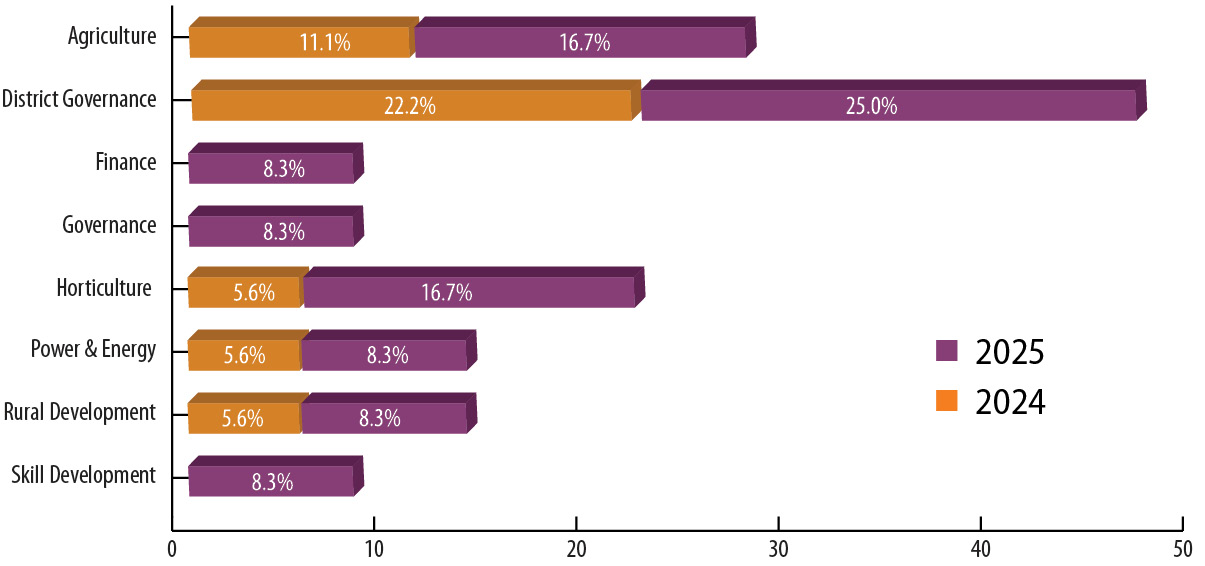
Compared to recent years, 2025 signals consolidation and recovery. The state performed very strongly in eight categories, with maximum improvement in Horticulture, Rural Development and Power & Energy and a notable comeback in Skill Development, Finance and General Administration.
Growth Ground Up
Bihar’s strongest gains this year are rooted in the rural economy. In Horticulture and Rural Development, the state ranks 3rd nationally, marking a significant rise in both categories.
It is a story of focused progress, visible in horticulture clusters supplying new markets, in rural infrastructure projects tracked digitally, in power grids stabilising supply and in skill centres aligning training with jobs
In Horticulture, expansion of fruit and vegetable clusters, improved cold storage facilities and better aggregation systems have strengthened farmer incomes. Structured market linkages and value-chain development are helping diversify agriculture beyond traditional crops. The sector’s growth reflects targeted intervention and close district-level monitoring. Rural Development, meanwhile, reflects improved delivery of housing, employment and local infrastructure schemes.
Strengthening Infrastructure
In Power & Energy, Bihar improved its standing to rank 4th nationally in 2025. Energy reform has focused on expanding last-mile connectivity, improving distribution efficiency and enhancing billing transparency. Digital monitoring systems track outages and supply quality more effectively. Infrastructure upgrades have reduced losses and strengthened grid stability. For households and small businesses, improved electricity reliability translates directly into economic opportunity. The rise in this category reflects both infrastructure investment and stronger administrative oversight.
Comeback Impact
Among the most notable comebacks is in Skill Development, where Bihar ranks 2nd nationally in 2025. Training programmes aligned with industry needs, structured placement tracking and partnerships with private enterprises have strengthened outcomes. The emphasis has shifted from enrolment numbers to employability metrics. Digital monitoring tools track trainee progress and placement success rates, creating accountability within training institutions. This performance signals a shift toward youth-centric governance, equipping Bihar’s large young population with structured pathways to employment.
Upgradation of ITIs as CoE
Deepak Anand
Secretary Directorate of Employment and Training
Under Bihar’s Saat Nishchay Part-2 scheme, the state is rewriting its economic narrative by transforming 149 Industrial Training Institutes (ITIs) into modern Centres of Excellence (CoE). Historically, Bihar’s massive youth population faced a frustrating paradox: high potential but limited local opportunity, often leading to a cycle of migration for low-skill labour.
Traditional ITI curricula had become relics of a bygone era, failing to keep pace with the rapid evolution of global manufacturing. To bridge this gap, the government committed `4,606 crore in a high-stakes partnership with Tata Technologies and 20 other industry leaders, aiming to turn a “demographic challenge” into a high-tech “demographic dividend.”
The impact is already tangible. By mid-2025, the programme had trained over 13,000 students, with thousands successfully placed in high-value roles that offer significantly higher wages than traditional paths.
The narrative is not about dramatic leaps. It is about sustained improvement, grassroots strengthening and institutional reinforcement – a state building momentum through steady, structured reform
Reinforcing the Core
Institutional reform is also visible in Finance, where Bihar ranks 3rd nationally and in General Administration, where it ranks 5th.
Sectors with Enhanced Focus – Bihar
In Finance, digital treasury systems, improved expenditure tracking and transparent fund management have strengthened fiscal discipline. Real-time dashboards allow departments to monitor allocations and utilisation more closely, reducing delays.
Bihar’s growth is envisioned as inclusive and growth-oriented. Based on development with justice, it prioritises farmers, youth and women, with initiatives like financial support for women’s employment, aiming to ensure equitable progress and broad-based socio-economic development across the state
Nitish Kumar Chief Minister, Bihar
When fiscal systems and administrative processes are strengthened together, delivery improves across sectors and Bihar’s 2025 performance reflects that synergy. District administrations are increasingly using dashboards and data-driven tools to monitor schemes. Structured reporting and evaluation frameworks are embedding accountability within local offices. This decentralised energy strengthens the state’s overall governance profile.
Incremental Strengthening
e-Proc 2.0
Abhay Kumar Singh
Managing Director Bihar State Electronics Development Corporation Limited
Replacing fragmented, semi-digital systems, this platform establishes a secure, fully automated and globally compliant electronic-tendering environment. It builds on Bihar’s early adoption of e-tendering by incorporating advanced functionalities such as multi-currency bidding, automated EMD refunds and sophisticated forward and reverse auction engines.
The project’s architecture was shaped by high-level consultations involving an Apex Committee of senior secretaries. The technical workflow followed five rigorous stages from requirement analysis to post-implementation monitoring ensuring the system could handle secure bid-packet access and real-time bidder verification using API-based identity validation.
By September 2025, it eliminated over 27 million pages of documentation, saving approximately 3,283 trees and avoiding 136.8 metric tons of CO2 emissions.
The cumulative trajectory from 2014 to 2025 shows Bihar gradually reinforcing institutional capacity. While the state stands at #11 nationally in 2025, the pattern of improvement across eight categories suggests upward momentum.
The state has done remarkably well across various indicators, primarily being Health, e-Governance and Municipal Governance, all on the backing of technology
Telangana has embarked on a visionary journey to establish itself as a leader in Artificial Intelligence with a promise for inclusive growth and development. The state has consistently been at...