A tribute to PM Modi for leading 25-years of Inclusive Growth
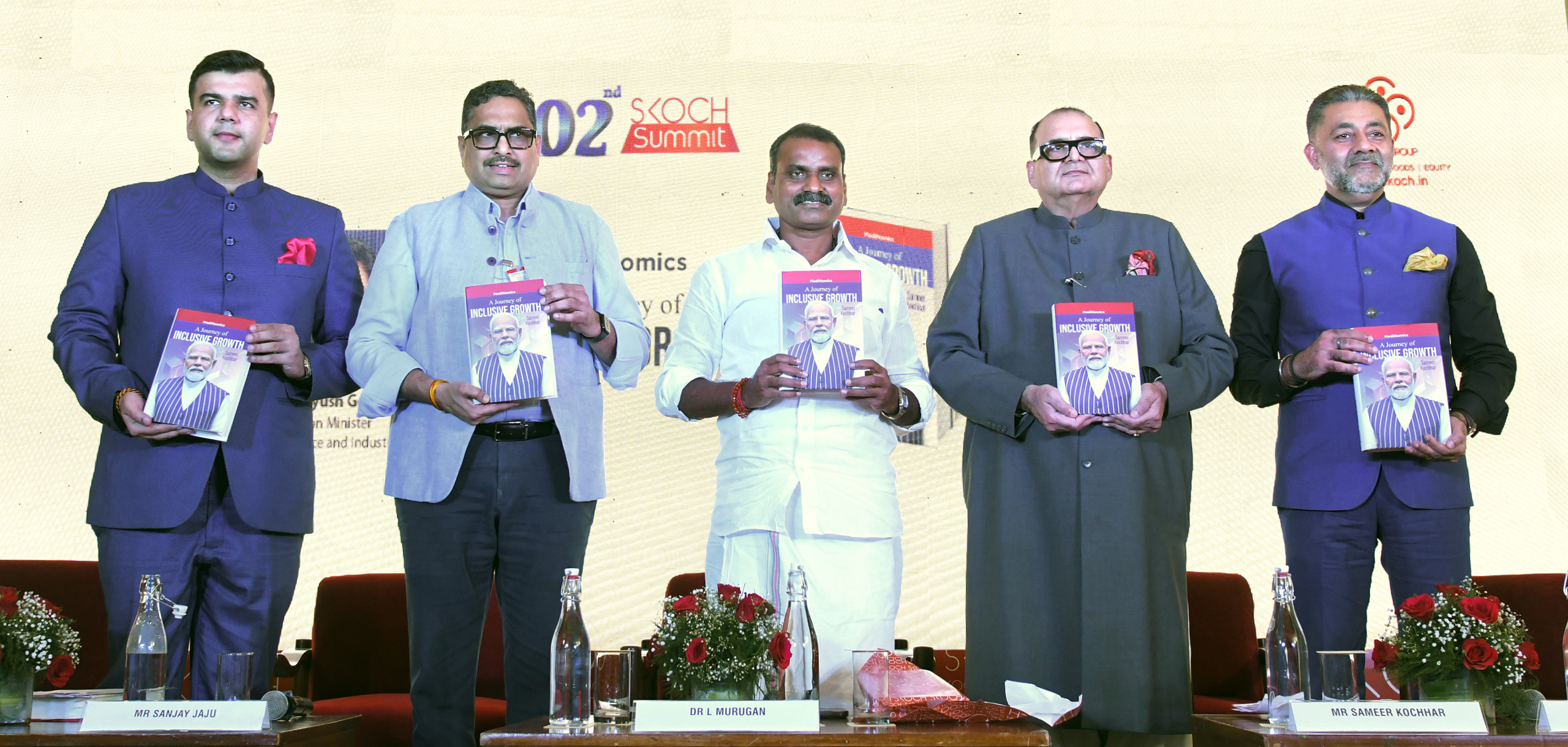
L Murugan, Minister of State for I&B and Parliamentary Affairs recently released an important book by Mr Sameer Kochhar, Chairman, SKOCH Group and Reforms Historian entitled “ModiNomics: A Journey of Inclusive Growth” that marks 25-years of Prime Minister Narendra Modi in public office. It is a definitive account of his governance and economic philosophy. From Jan Dhan to Ujjwala to Swachh Bharat to Digital India, it explores how millions were brought into the mainstream of development with speed and scale.
While releasing the book Murugan said, “I am very happy to participate in this programme to launch the book based on our Hon’ble Prime Minister’s journey. This book is about the history of a legend. Continuously for 25-years, he has been serving the public, first as the Chief Minister of Gujarat and now as the Prime Minister of India. I must congratulate SKOCH Group and Sameer Kochhar, for capturing such a remarkable work on the occasion of our Hon’ble PM’s 75th birthday.” He further added, “Writing such a work that captures all of 25-years of Mr Modi being in the government, must have been a herculean task as it touches upon each and every citizen oriented scheme launched in Gujarat and thereafter at the centre under the leadership of the Hon’ble Prime Minister.”
Sanjay Jaju, Secretary, Ministry of I&B said, “It is indeed befitting that ModiNomics is being released at a time when we are all part of Seva Pakhwada going on in the country. This is a time when all of us in the government and in civil society get our acts together and take forward the agenda and realise the vision that our Hon’ble Prime Minister has laid out, starting from his birth date, 17th Sept to 2nd Oct.”
According to the author of the book, Sameer Kochhar, “Documenting India’s economic reforms and journey of governance transformation since 1991 requires both skill and courage. Prime Minister Modi’s approach to economics is unique because it focuses on inclusive growth and governance. This vision inspired my books, including ‘ModiNomics’ way back in 2014 followed by ‘Defeating Poverty – Jan Dhan and Beyond,’ highlighting initiatives like Jan Dhan Yojana that aim to truly transform lives.”
This book examines both the vision and the outcomes; financial inclusion, welfare delivery, infrastructure and digital empowerment – that have shaped India’s transformation.
From Gujarat to the Nation India’s Green Growth Journey
Over the last decade or so, nearly 27 crore people have been pulled out of extreme poverty. India has simultaneously risen to be the fourth-largest world economy. From being among the ‘Fragile Five’ economies to now pacing towards being the third-largest economy India has scripted a story of ‘dreaming big and delivering even bigger’. It is a story of executing ambition. And all this has been made possible due to the ‘Can Do’ approach of India’s Prime Minister Shri Narendra Modi ji. The book ModiNomics captures in detail Modi ji’s ‘courage of hope’ and story of ‘matching action with ambition’ over 25 years – first as the Chief Minister and then as Prime Minister to a nation of 140 dreams, hopes and aspirations.
Offering a glimpse into Modi ji’s visionary leadership during his chief ministership, Shri Sameer Kochhar writes, “As Chief Minister Modi’s tenure in Gujarat progressed, a distinct administrative style emerged – one combining business-like efficiency with visionary zeal. He was often described as a ‘man in a hurry’, impatient to get things done and done right. In bureaucratic meetings, he would zero in on execution details: ‘Great policy, but who is monitoring it on the ground? What is the timeline? Where are the bottlenecks?’ These questions he would throw at officials. Narendra Modi’s administrative persona also combined strict accountability with motivational leadership. He could be a hard taskmaster – bureaucrats in Gujarat learned quickly that monthly review meetings meant coming fully prepared with facts and figures at their fingertips.”
This book is a must read for those trying to understand how India scripted the story of an economic turnaround – from ‘Fragile Five’ to world’s largest fastest growing economy.
Bhupender Yadav
Union Minister of Environment, Forest and Climate Change
How Modi’s Tribal Vision Became a National Movement
When Union Minister for Tribal Affairs Jual Oram recalls his early association with Prime Minister Narendra Modi, his memories go beyond politics — they’re about people. “When he became Chief Minister, he used to call me often to work in tribal areas — particularly in South Gujarat: Banaskantha, Surat, Dang,” Oram says. “We worked closely with the tribal communities for their welfare and empowerment.”
Those efforts in Gujarat became the foundation for what is now India’s national framework of tribal inclusion. Under Modi’s leadership, Gujarat launched the Vanbandhu Kalyan Yojana (VKY) — a path breaking model of integrated tribal development that combined livelihoods, education, housing and health into a single, community driven mission. “He would pick one area and do all-round development — from roads to schools to welfare,” recalls Oram.
The Gujarat model was built on participatory planning and outcome-oriented governance. Local priorities determined the projects, reflecting Modi’s insistence that development should be based on felt needs, not administrative assumptions. “No project should stop for want of funds,” Oram adds, underscoring his belief in result-driven implementation.
When Modi became Prime Minister, these ideas were scaled nationally. Flagship programmes such as Vanbandhu 2.0, Eklavya Model Residential Schools and the Pradhan Mantri Janjati Adivasi Nyaya Maha Abhiyan (PM-JANMAN) continue the same logic: community-led, data-driven and locally accountable governance.
The book carries two chapters on Tribal Development as a subject close to the heart and policies of Prime Minister Modi. Ground-level evidence from SKOCH Development Foundation reinforces this transformation. In Sundargarh district of Odisha, SKOCH documented success stories such as the Drink from the Tap (Har Ghar Jal) initiative, Banana and Mushroom plantations boosting livelihoods and Eklavya Model Residential Schools (EMRS) at Bhawanipur and Liang. Over 100 such best practices from across India form the Digital Knowledge Repository on Tribal Affairs — spanning not only state Tribal Affairs departments but also sectors like health, education and digital governance that shape tribal life.
COAL AS A PILLAR OF INCLUSIVE GROWTH
“Energy inclusion is the truest reflection of good governance—it lights homes, livelihoods and confidence.” This powerful sentiment from ModiNomics captures the essence of India’s development story. At the heart of this transformation stands coal, often misunderstood as a relic of the past but, in India’s context, a pillar of inclusive growth and a bridge to a cleaner future.
The modernisation of coal mining—through mechanisation, improved logistics and environmental safeguards—has ensured that energy inclusion remains both viable and sustainable. By expanding access to affordable electricity, the sector supports not only industry but also dignity—creating jobs across India’s vast and diverse regions.
The coal sector’s transformation mirrors the governance reforms that ModiNomics celebrates—marked by competition, digitisation and accountability. The introduction of commercial coal mining auctions has opened the sector to private investment and innovation, replacing opaque systems of allocation with transparent bidding.
Digital monitoring through the Mine Surveillance System (MSS) and real-time production tracking has curbed illegal mining and enhanced state revenues. Streamlined clearances and investor-friendly policies under the Ease-of-Doing Business framework have turned coal from a controlled commodity into a strategically managed resource.
This governance model—anchored in efficiency and transparency—reflects the broader philosophy of Minimum Government, Maximum Governance.
“Sustainability and inclusion must move together.” This guiding principle defines the coal sector’s new direction. Initiatives such as mine closure and land reclamation, coal bed methane (CBM/CMM) utilisation and Eco-Park development highlight the sector’s growing environmental consciousness.
The focus on Just Transition ensures that workers and communities dependent on coal are not left behind. Retraining programmes, land restoration and regional diversification are central to this effort. Meanwhile, projects promoting coal gasification, liquefaction and cleaner technologies strengthen the vision of Atmanirbhar Bharat, supporting innovation and reducing import dependency.
From Gujarat’s Jyotigram Yojana to national programmes like Ujjwala and Saubhagya, India’s energy journey has demonstrated how reliable and affordable power drives equity. Coal’s evolving role—from a simple fuel to a developmental backbone—now supports renewables, green hydrogen and industrial decarbonisation.