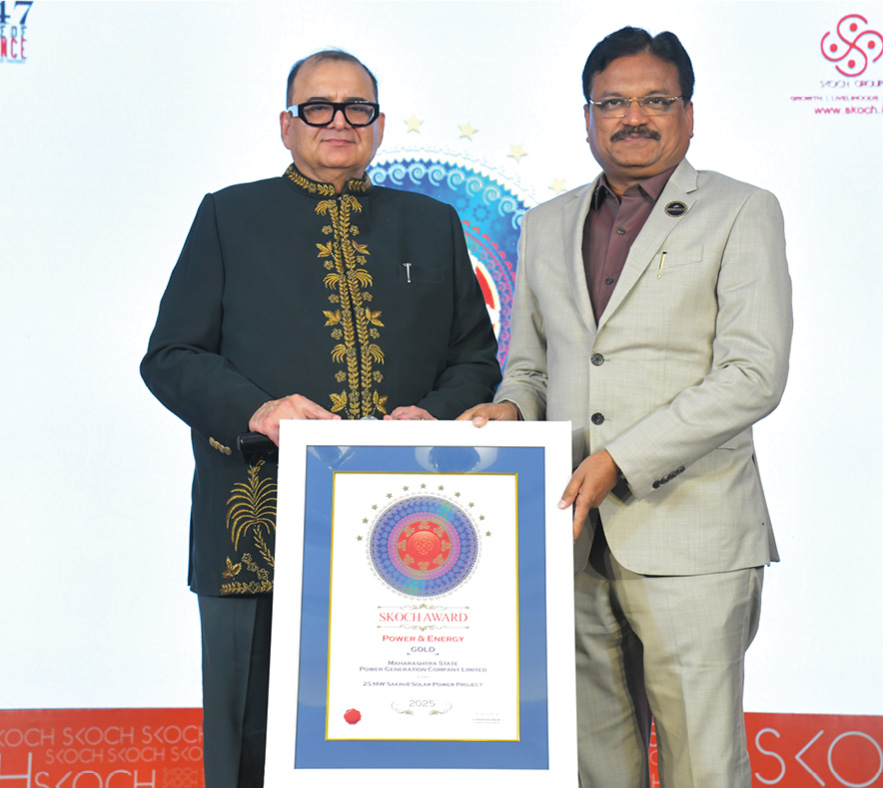
Maharashtra State Power Generation Company Limited’s (MSPGCL) 25 MW Sakri-II Solar Power Project marks a significant milestone in the state’s transition towards affordable, reliable and sustainable energy. Located at Shivajinagar in Sakri taluka of Dhule district, the grid-connected solar photovoltaic plant reflects MAHAGENCO’s strategic response to rising power demand and India’s long-term commitment to achieve net-zero emissions.
Commissioned in April 2024, the project has an annual generation potential of 58.1 million units with a capacity utilisation factor of 26.53 per cent. Developed at a capital cost of ₹187.54 crore over 44.41 hectares, Sakri-II demonstrates how large public sector utilities can successfully integrate renewable energy into the mainstream grid while ensuring commercial viability. Power from the plant is supplied through a balanced mix of open access and competitive power purchase agreements, including long-term and short-term contracts discovered through transparent reverse auctions.
Beyond clean energy generation, Sakri-II addresses two critical challenges: reducing carbon intensity of power generation and delivering affordable electricity to consumers. The project also showcases strong governance practices, including efficient land acquisition, competitive bidding, real-time monitoring, timely commissioning and market-linked power sales.
Importantly, Sakri-II builds on the success of Sakri-I, together creating a 50 MW solar hub that offers a scalable and replicable model for future renewable projects across Maharashtra. This aligns with MAHAGENCO’s broader vision of expanding renewable capacity and strengthening sustainability, as highlighted in its roadmap to significantly increase the share of renewable energy in its overall portfolio.
With a designed project life of 25-years and O&M costs capped at ₹5.8 crore for the first five years, Sakri-II strengthens long-term cost efficiency. Structured monitoring, commissioning trials and performance oversight ensure operational discipline across the asset lifecycle.
At the same time, MAHAGENCO’s parallel initiatives – such as the installation of Flue Gas Desulphurisation (FGD) systems at thermal units – demonstrate a holistic approach to sustainability by reducing emissions from conventional power generation. Together, renewable expansion and emission-control technologies position the utility as a leader in balancing energy security with environmental responsibility.
As Maharashtra prepares for a projected power demand of 45 GW by 2035, initiatives like Sakri-II underline the pivotal role of state PSUs in advancing India’s clean energy transition while ensuring fiscal prudence and reliable power supply.
"American roads are good not because America..
State Rankings Highlights -: Odisha scaled to number..
In the run-up to the elections, the most..
Step 1: Call for Project Submission Call for..

Inclusion is the first magazine dedicated to exploring issues at the intersection of development agendas and digital, financial and social inclusion. The magazine makes complex policy analyses accessible for a diverse audience of policymakers, administrators, civil society and academicians. Grassroots-focused, outcome-oriented analysis is the cornerstone of the work done at Inclusion.