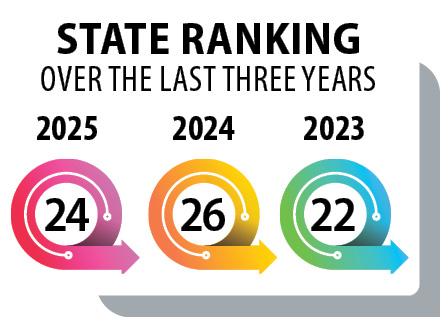
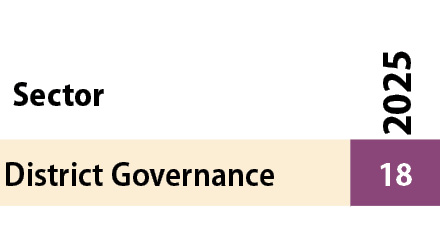
Arunachal Pradesh ranks #24 nationally in the SKOCH State of Governance Report 2025. For a geographically remote, sparsely populated Northeastern hill state where delivery often depends on terrain as much as policy, participation itself carries weight.
This year’s performance is modest in scale but pointed in impact. Two projects from the state qualified as well-performing and both were categorised as impactful. That detail matters. When output is limited in number yet recognised for impact, it signals focus rather than dispersion.
Impact Over Volume
Arunachal’s 2025 profile reflects selective engagement. With only two qualifying initiatives, both impactful, the state’s contribution is concentrated rather than expansive.
In national benchmarking exercises, larger states often submit dozens of entries across multiple departments. Arunachal’s strategy appears different: fewer submissions, sharper emphasis. The recognition of both projects as impactful suggests that they met measurable outcome thresholds rather than remaining procedural efforts.
Empowered grassroots institutions are key to nation-building, driving inclusive development and local progress. Arunachal Pradesh is advancing towards balanced growth under the ‘PEMA 3.0 – Year of Reforms & Growth’ initiative
Pema Khandu Chief Minister, Arunachal Pradesh
While the aggregate rank stands at #24, the quality of participation demonstrates administrative intent.
Governance in Challenging Terrain
Public administration in Arunachal Pradesh operates under constraints unfamiliar to most states , mountainous topography, dispersed settlements and infrastructural limitations. Every welfare initiative or infrastructure rollout must navigate logistical complexity.
Even a small cluster of evaluated initiatives helps departments internalise documentation standards and outcome measurement
Against this backdrop, impactful projects carry additional significance. They indicate that implementation has not only occurred but delivered measurable results despite geographic barriers.
Digi Kaksha
Vishakha Yadav
Collector and District Magistrate Papum Pare
Areas like Kurung Kumey and Deomali previously faced severe teacher shortages and poor infrastructure, which were reflected in pre-board results averaging below 30%. In response, the administration developed an integrated digital learning ecosystem designed to bridge the gap between geographic isolation and quality education, ensuring that students in even the most inaccessible regions have access to modern pedagogical tools. The initiative features thematic learning centers equipped with interactive, Android-based learning boxes containing bilingual, CBSE-aligned digital content for levels ranging from pre-primary to Class XII.
Within months, student engagement rose by 10% and Class X pre-board scores more than doubled to 55.8%. Notably, 61 local students qualified for the state’s public service commission prelims for the first time. The project also empowered the broader community, training 285 Anganwadi workers in digital monitoring tools.
National ranking systems often reward scale. For states like Arunachal, execution under constraint becomes the defining marker.
Towards Progress
The cumulative ranking from 2014 to 2025 shows Arunachal participating intermittently within a competitive federal landscape. The 2025 performance, though modest in volume, positions the state firmly within the national evaluation framework.
In governance benchmarking, engagement itself is strategic. It provides visibility, comparability and scope for calibrated improvement.
Beyond the Rank
Ranking #24 nationally places Arunachal in the lower band of the table, yet the year’s narrative is less about ordinal placement and more about institutional presence.
For Arunachal Pradesh, governance is often about bridging distance, physical and administrative. Each evaluated initiative represents systems reaching communities across hills and valleys. The scale may be smaller, but the context is larger.
The state has done remarkably well across various indicators, primarily being Health, e-Governance and Municipal Governance, all on the backing of technology
Telangana has embarked on a visionary journey to establish itself as a leader in Artificial Intelligence with a promise for inclusive growth and development. The state has consistently been at...