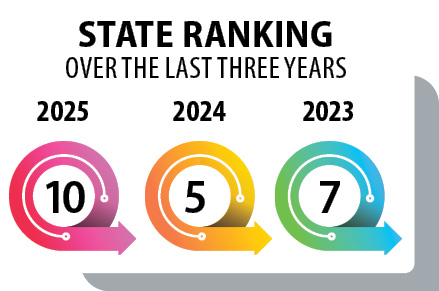
Over the past decade, West Bengal’s journey in the State of Governance rankings has reflected both fluctuation and resilience. From phases of stronger upward movement to years of consolidation, the state has remained a consistent presence in the upper tier. In 2025, West Bengal retained its position in the national top ten, ranking #10 in India, a sign of stability amid intensifying competition among states. Eleven well-performing projects from the state qualified for deeper study.
Compared to the previous couple of years, the 2025 performance reflects consolidation rather than dramatic swing. Instead of spreading reform energy across too many fronts, West Bengal appears to have sharpened its focus on core administrative and grassroots sectors particularly Revenue and Rural Development and strengthened them decisively.
Administrative Reform at its Strongest
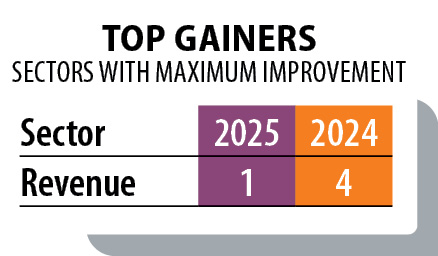
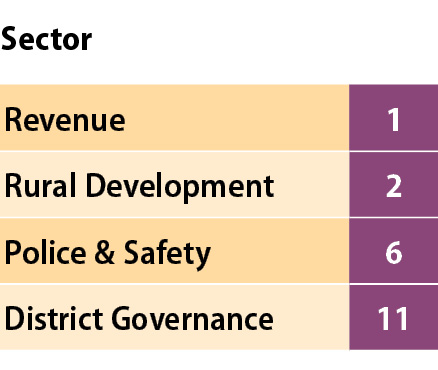
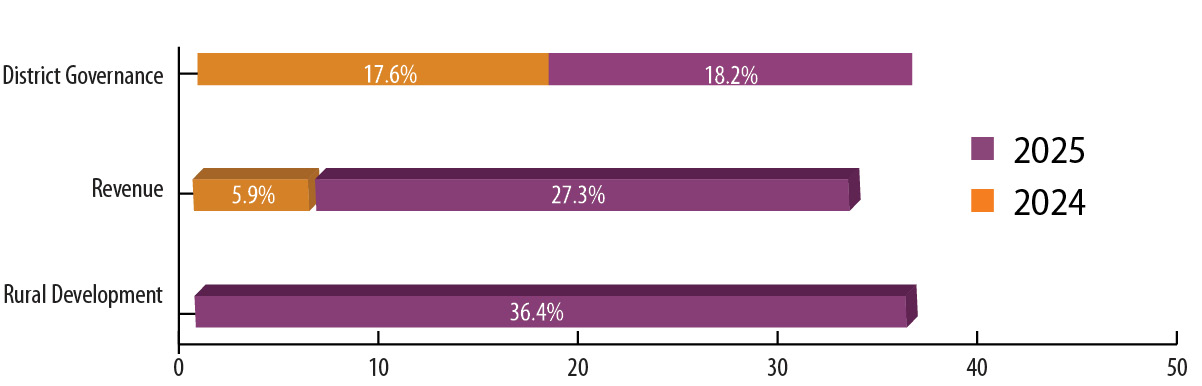
The most striking feature of West Bengal’s 2025 performance is its leadership in the Revenue category, where it tops the country. Revenue administration rarely dominates public discourse, yet it forms the backbone of governance, land records, tax systems, dispute resolution and service delivery mechanisms all pass through it.
West Bengal’s story this year is one of alignment: financial systems reinforcing rural development, district-level participation strengthening documentation and administrative reform sharpening service delivery
The state’s improvement in this category reflects systematic digitisation of land records, streamlined mutation services and faster citizen-facing processes. Technology-enabled monitoring and integrated record systems have reduced procedural delays. Revenue courts and service counters increasingly rely on digital workflows rather than paper-heavy systems. Topping the Revenue category nationally is not merely symbolic. It signals that the financial and administrative foundations of governance are becoming more transparent, efficient and citizen-friendly.
Grassroots Resurgence
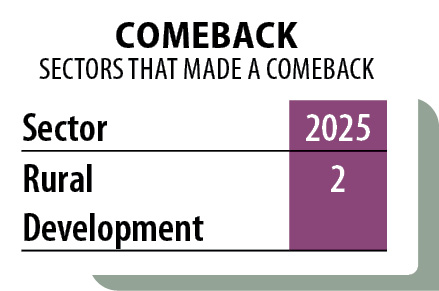
If Revenue represents structural reform at the administrative core, Rural Development reflects delivery on the ground. In 2025, West Bengal ranks second nationally in this category, marking a strong comeback.
Rural Development touches housing, employment schemes, local infrastructure and community assets, the tangible aspects of governance that shape everyday life. The state’s improved standing suggests tighter monitoring of rural schemes, better district-level coordination and stronger documentation of outcomes.
West Bengal’s 2025 performance is characterised by concentrated excellence rather than broad dispersion. The state performed very strongly in four categories, with Revenue and Rural Development leading the narrative
Digital dashboards and structured reporting mechanisms are strengthening oversight. Funds are tracked more transparently. Scheme implementation timelines are monitored more closely. The result is a more predictable and accountable rural delivery system.
Sectors with Enhanced Focus – West Bengal
The synergy between Revenue and Rural Development is particularly significant. Improved fiscal systems generate stronger resource flows, which in turn support grassroots implementation.
Nirmal Purbasthali – ODF Plus Model Gram Panchayat
Ayesha Rani
Executive Officer and District Magistrate Purba Bardhaman Zilla Parishad
Purbasthali Gram Panchayat, already declared ODF in 2023, undertook the ambitious goal of becoming the first ODF Plus Model Gram Panchayat in Purba Bardhaman District. The initiative was launched in February 2025, with active involvement of Panchayat Samiti officials, SHGs and the community.
By March 2025, a dedicated SWM unit was established and operationalised, ensuring systematic waste collection from all households. To sustain the system, a nominal subscription of `20 per household per month was introduced from April 2025. Greywater management units were completed by May 2025, ensuring no untreated wastewater was discharged into the Ganga. Simultaneously, the Panchayat restored all sanctioned household and institutional toilets by June 2025, ensuring universal toilet access.
Cleaning drives transformed garbage-laden ponds into healthier water sources, benefiting both residents and the ecology. Recognising the area’s tourist significance due to the Migratory Bird Park, the Panchayat instituted a user fee for tourists to maintain cleanliness in the park surroundings.
Focused Strength
West Bengal’s 2025 performance is about concentrated excellence rather than broad dispersion. The state performed very strongly in four categories, with Revenue and Rural Development leading the narrative.
e-Nathikaran
Launched by Directorate of Registration and Stamp Revenue in December 2014, e-Nathikaran was designed to make registration processes transparent, citizen-centric, secure and efficient while simultaneously plugging revenue leakages and strengthening regulatory oversight. The Directorate is one of the highest revenue-earning departments of the state, registering nearly 20 lakh deeds annually and contributing over Rs 6,000 crore to the exchequer, making systemic reform both critical and high-impact.
Aadhaar-based biometric verification and PAN validation significantly reduced impersonation and identity fraud, while digitisation of legacy records ensured data security.
This focused approach suggests prioritisation. Instead of attempting sweeping gains across numerous sectors, the state has reinforced areas that directly influence fiscal capacity and grassroots delivery. The emphasis appears to be on depth and measurable change rather than sheer volume.
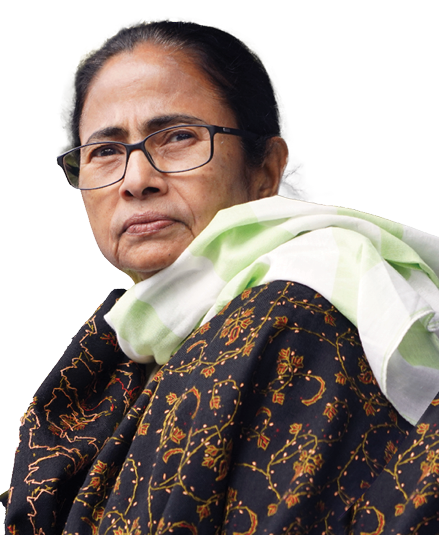
We have remained united despite its religious, caste and linguistic diversity. We generated jobs during the pandemic, supported MSMEs and empowered women, farmers, artisans and youth through welfare initiatives for inclusive and sustained growth
Mamata Banerjee Chief Minister, West Bengal
A Decade of Evolution
Looking at the cumulative trajectory from 2014 to 2025, West Bengal’s governance journey reflects steady institutional evolution. Rankings have shifted year to year, but the state has maintained its presence within the competitive band.
Plastic Waste Management in Rural Bengal
Santhosa G R
Mission Director Panchayats & Rural Development Department
With a target of establishing 148 PWM facilities across 345 blocks, the state is addressing the escalating crisis of plastic pollution in rural ecosystems. By focusing on the systematic collection, segregation and high-value repurposing of plastic, the project aims to prevent non-biodegradable waste from contaminating local water bodies and landfills while simultaneously strengthening rural infrastructure.
The core of the solution lies in an integrated collection and processing network. Efficient door-to-door collection services prioritise source segregation, ensuring that high-density polyethene (HDPE) and low-density polyethene (LDPE) are recovered in high-quality states. Each block-level PWM unit is strategically tagged with professional recyclers to handle recyclable materials. However, the true innovation is the use of non-recyclable plastic in road construction.
The project has successfully institutionalised waste-to-wealth practices in 80 blocks.
The 2025 result demonstrates continuity. Retaining a top-ten position amid rising benchmarks indicates institutional resilience. While some states experience sharp rises followed by declines, West Bengal’s pattern suggests steadier consolidation.
The state’s governance arc shows adaptation and persistence. In 2025, West Bengal demonstrates that stability in ranking can be as meaningful as rapid ascent, especially when it is anchored in structural reform and focused improvement
The improvement in Revenue and resurgence in Rural Development illustrate how targeted strengthening can stabilise overall performance.
Rooted in Systems
Across district revenue offices and rural development blocks, governance in West Bengal increasingly revolves around systems rather than discretion. Digitised service counters replace manual registers. Monitoring dashboards replace periodic reviews. Data-backed oversight strengthens accountability.
Modern Web-Based Land Services for Citizens
Vibhu Goel
Director of Land records and Surveys and Joint Land Reforms Commissioner
Aligned with the Digital India Land Records Modernisation Programme (DILRMP), the project was launched in January 2020 to address long-standing challenges such as language barriers, dependence on intermediaries, preservation of legacy land records and limited citizen access to land-related services.
At the core of the initiative is the Banglarbhumi portal, which provides 24×7 access to digitised Records of Rights, plot maps, court case details and land-use restrictions in all scheduled languages. Citizens can apply online for mutation, land conversion, succession, certified copies and land revenue payment without visiting offices.
The portal has recorded over 33 crore visits, accounting for more than 80 per cent of all e-transactions in West Bengal. Each year, around 64 lakh certified copies and nearly 70 lakh mutation cases are processed, with a majority initiated directly by citizens online. Since 2022, the online revenue system has enabled the collection of over Rs 158 crore in land revenue.
This shift may appear procedural, but its impact is human. Faster land record corrections mean quicker property transactions. Transparent rural housing tracking means beneficiaries see visible progress.
Police Bondhu
Dinesh Kumar
Superintendent of Police Bongaon District Police
Launched in January 2025, the Police Bondhu initiative in West Bengal’s Bongaon District represents a digital-first approach to community policing. Conceived under the leadership of the Superintendent of Police, the project sought to bridge the transparency gap between law enforcement and the public. By replacing fragmented manual records with a unified, multilingual web platform, the initiative enables citizens to track FIRs and submit grievances online.
The technical architecture of Police Bondhu is built on role-based access and real-time supervisory dashboards. Investigating officers follow structured digital workflows, while senior leadership can monitor case progress and flag delays in real time. This system ensures high data security through encrypted communication and regular audits, in compliance with national data protection standards. To ensure inclusivity, the interface was designed to be “lightweight,” remaining functional even in rural pockets with limited connectivity. The project has impacted over 1.5 million beneficiaries, demonstrating its immense scalability and public acceptance.
The state’s performance this year underscores that governance excellence often lies in strengthening the less visible foundations, fiscal clarity, administrative precision and grassroots implementation.
The state has done remarkably well across various indicators, primarily being Health, e-Governance and Municipal Governance, all on the backing of technology
Telangana has embarked on a visionary journey to establish itself as a leader in Artificial Intelligence with a promise for inclusive growth and development. The state has consistently been at...