The governance rankings are reflections of delivery systems that work. In 2025, Madhya Pradesh’s message is clear: reform has moved from intent to institutional habit
In 2025, Madhya Pradesh has scripted one of its strongest governance performances in recent years, climbing into the national top tier and consolidating its position as a reform-driven state.
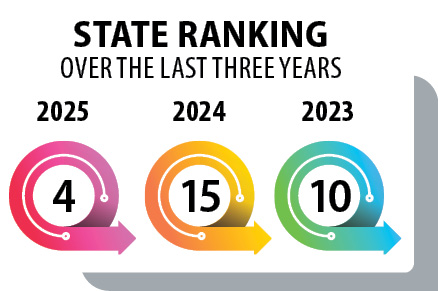
After five years of steady effort and institutional recalibration, the state has entered the top five nationally in the SKOCH State of Governance Report 2025. It ranks #4 in the country this year, marking a decisive moment in its governance journey. A total of 31 well-performing projects qualified for deeper study this year.
This rise is not a statistical accident. It is the outcome of depth, spread and sustained administrative momentum across sectors. Governance in the state is no longer driven by isolated flagship initiatives; it is increasingly characterised by institutional consistency.
A Climb Built on Sectoral Strength
The 2025 performance reflects strength in as many as 12 governance categories. That spread is critical. It signals that state’s governance architecture is not skewed toward a single sector but has matured across domains – rural, urban, administrative and social.
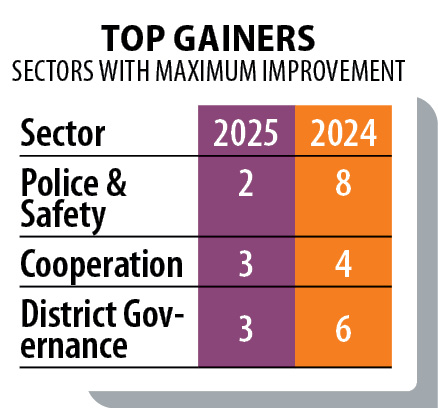
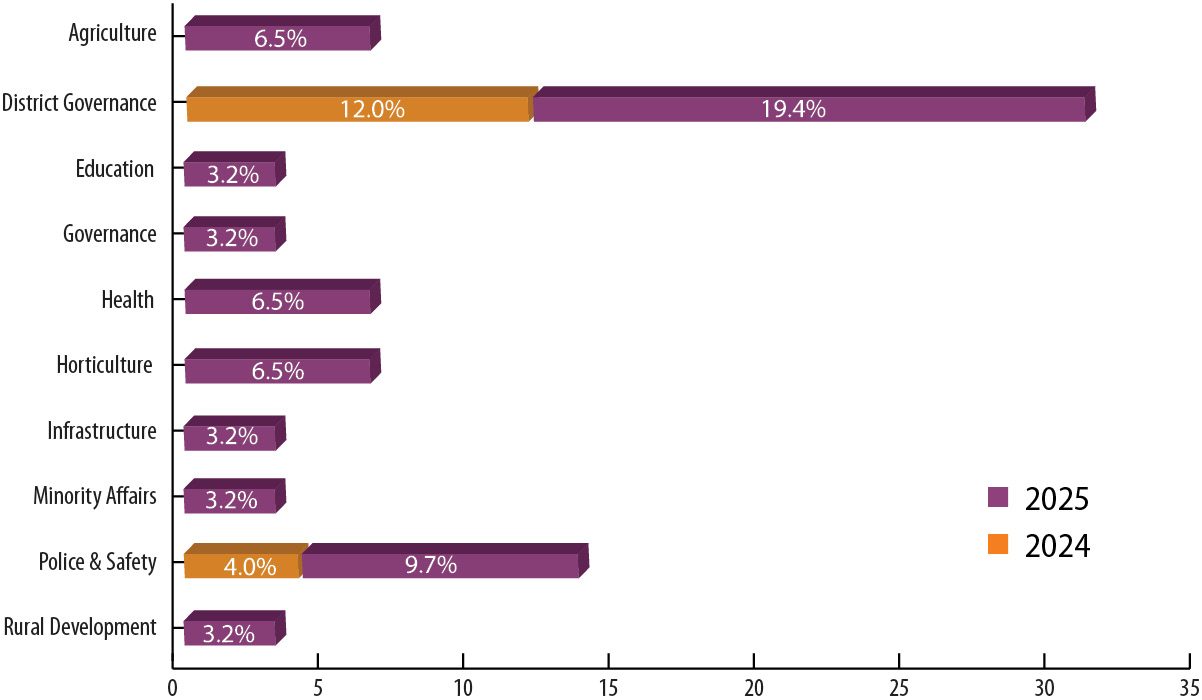
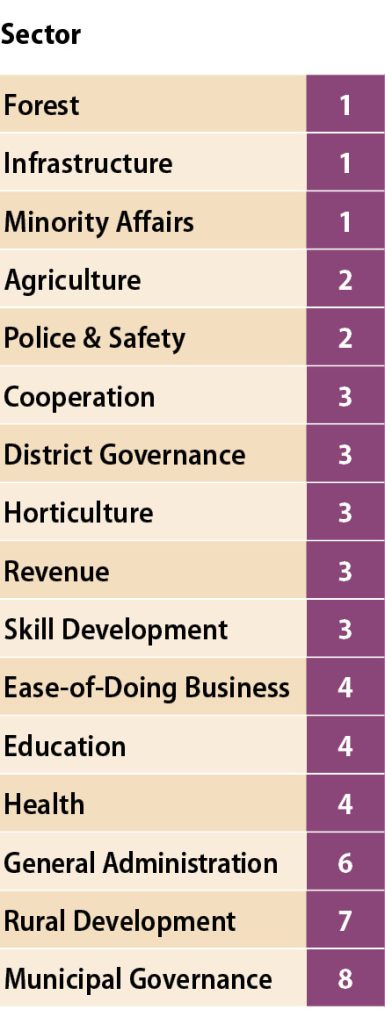
The most striking gains have come in Police & Safety, Cooperation and District Governance. In Police & Safety, Madhya Pradesh has surged to #2 nationally in 2025. This leap suggests significant strengthening of law-and-order systems, citizen interface mechanisms and administrative responsiveness at the ground level. Improvements in policing often reflect deeper investments in technology, coordination and decentralised monitoring, indicators of systemic reform rather than short-term measures.
Similarly, the state has moved up in both Cooperation and District Governance. District Governance is often the true test of administrative efficiency. It is at the district level that policies either translate into services or remain on paper. Rising to the third position nationally points to improved district-level execution better coordination between line departments, stronger monitoring and enhanced citizen service delivery frameworks.
One of the striking highlights this year is Madhya Pradesh’s national leadership in sustainability-linked governance. The state has recorded maximum improvement in three sectors: Cooperation, District Governance and Police & Safety
Sectors with Enhanced Focus – Madhya Pradesh
Consistency Where It Matters
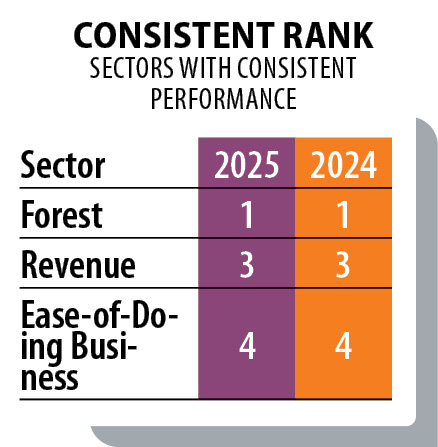
If improvement defines one part of Madhya Pradesh’s 2025 story, consistency defines another. The state continues to top the Forest category nationally. Sustaining leadership in forest governance is no small feat in a state with significant tribal populations, ecological diversity and competing development pressures. Continued national leadership suggests a calibrated balance between conservation, livelihoods and regulatory oversight.
In Revenue, the state retains its position nationally. Revenue administration is often a proxy for institutional discipline covering land records, collections, digitisation and grievance redressal. Retention of rank indicates durable reforms rather than episodic improvement.
Ease-of-Doing Business remains another area of stable performance, with Madhya Pradesh holding the #4 position nationally. Stability here reflects predictable regulatory systems, streamlined approvals and digital facilitation. This signals proactive institutional engagement rather than passive participation.
The state continues to top the Forest category nationally. Sustaining leadership in Forest is no small feat in a state with significant tribal populations, ecological diversity
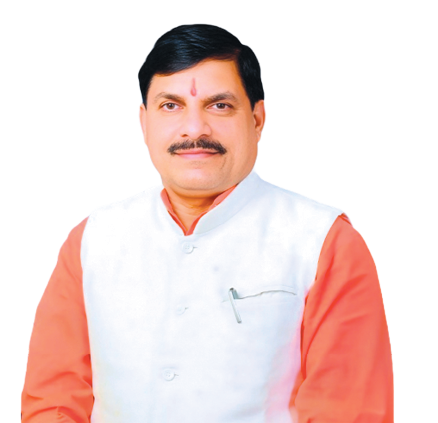
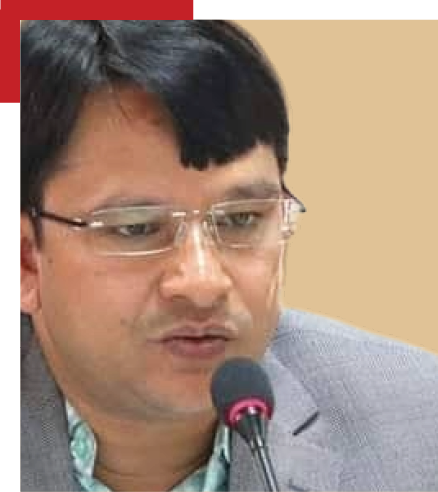
Madhya Pradesh is steadily advancing towards becoming a developed state, with focused efforts to empower villages, the poor, farmers, youth and women, ensuring inclusive development where no region is left behind and progress benefits all
Mohan Yadav Chief Minister, Madhya Pradesh
Comeback Narrative
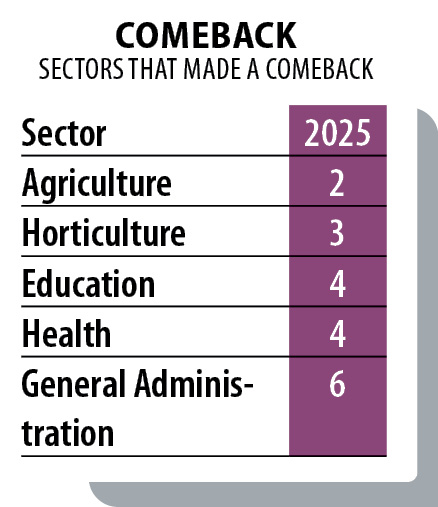
Perhaps the most compelling thread in Madhya Pradesh’s 2025 performance is the comeback across critical social sectors.
In Agriculture, the state now ranks #2 nationally. In Horticulture, it stands at #3. Agriculture remains the backbone of the state’s economy and climbing to second position nationally suggests improved productivity frameworks and extension systems.
SAMPADA 2.0
Swapnesh Sharma
Project Officer and Senior District Registrar
Conceived after a comprehensive assessment in 2021, the project aimed to replace the semi-digital SAMPADA system with an integrated, legally robust and user-friendly platform. The project began with a multi-stakeholder gap analysis, identifying inefficiencies in manual verifications, fragmented databases and the need for physical document presentation. With support from MPSeDC, a phased roadmap was designed, embedding Aadhaar-based e-KYC, GIS mapping, treasury integration, automated deed drafting and e-stamping.
Piloted in four districts in early 2024, the system was fine-tuned based on on-ground feedback and fully deployed across the state in October 2024. It offered browser-based, device-agnostic access to citizens and officials alike. Key features include biometric identity validation, contactless document execution. As of May 2025, the system had facilitated nearly 2.7 lakh registrations and generated over Rs 1,600 crore in revenue.
Education and Health, two sectors that define long-term human development have also re-entered the national top tier. These sectors often reflect the complexity of last-mile governance. Improvements here typically point to better monitoring, infrastructure strengthening, digitisation of services and administrative accountability.
In General Administration, state’s ranking is reflecting improvements in cross-departmental coordination and bureaucratic efficiency. These are not isolated gains. They represent recovery and renewed administrative focus in sectors that directly affect citizens’ daily lives.
Gift a Desk Seoni
Sheetla Patle
Collector Seoni
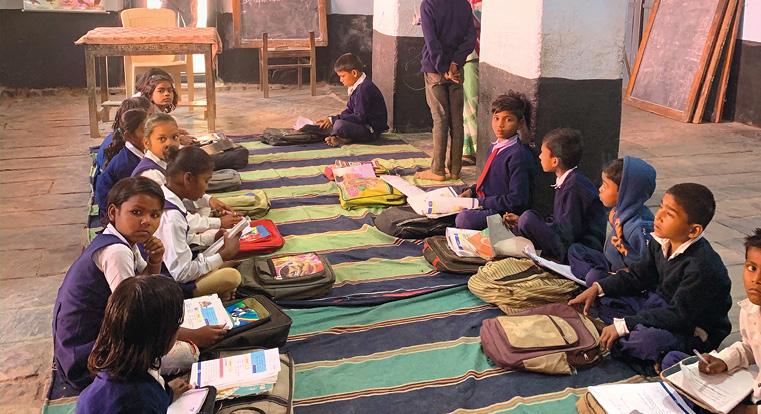
The Gift a Desk Seoni initiative is a citizen-driven campaign addressing one of the most basic yet overlooked aspects of rural education: classroom comfort and infrastructure. In 1,367 government primary schools across the district, children had been studying while sitting on the floor due to a lack of desks and benches.
The administration initiated a transparent, participatory mechanism inviting citizens, alumni, corporates and NGOs to “gift” desks to schools. A detailed survey identified schools needing intervention and each desk-bench set was standardised at `2,200 to maintain uniformity and cost clarity. A public Google Sheet and project website allowed donors to choose a school, track their contribution and view delivery updates in real-time.
To ensure quality and scalability, the project engaged local furniture manufacturers, creating livelihood opportunities and infusing Rs 2.8 crore into Seoni’s local economy. The campaign reached 1,021 schools, delivering 14,003 desks and benches that benefit nearly 28,000 students.
First-Time Participation
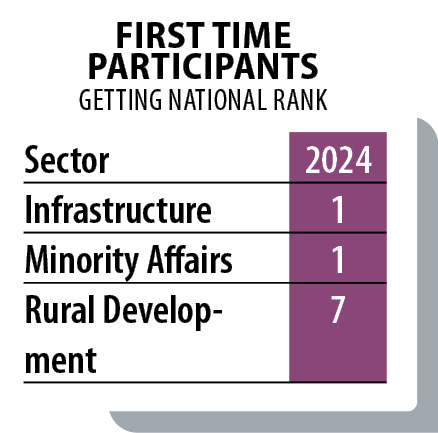
Another notable feature of the 2025 performance is the state’s confident entry into new categories. Participating for the first time in certain sectors, Madhya Pradesh has made an immediate mark. It tops the Infrastructure and Minority Affairs categories nationally. Achieving a top national position in a debut year speaks of the maturity of project design and documentation as well as the scale of execution already underway.
In Rural Development, another first-time category, Madhya Pradesh ranks #7 nationally. Entering the top ten at the first attempt reflects strong rural programme implementation particularly significant in a state with vast rural geography and diverse socio-economic challenges.
Participating for the first time in certain sectors, Madhya Pradesh has made an immediate mark. It tops the Infrastructure and Minority Affairs categories nationally
eMANDI App
Kumar Purushottam
Commissioner cum MD Madhya Pradesh State Agriculture Marketing Board
The eMANDI App, a flagship initiative by the Madhya Pradesh State Agricultural Marketing Board (MPSAMB) and NIC, marks a transformative shift in agricultural governance. Designed to modernise the state’s mandi system, the platform replaces manual, error-prone workflows with a standardised digital ecosystem. By integrating real-time transaction recording, e-permit generation and automated settlement processing, the app addresses the core challenges of information asymmetry and administrative delays. It provides a transparent, legally compliant interface where every movement of produce from arrival at the gate to final payment is logged, time-stamped and verified against state regulations.
Implemented across 259 mandis and 303 sub-mandis, the app’s modular architecture enables seamless integration of vital services. Traders utilise the platform for e-registrations and movement permits, while mandi officials use real-time dashboards to monitor trade volumes and commodity prices remotely. A key innovation is the generation of digital Sauda Patraks (purchase documents) and e-receipts, which hold legal weight under the MP Krishi Upaj Mandi Adhiniyam, 1972.
Prevention of Cyber Crime
Harinarayanachari Mishra
Police Commissioner Madhya Pradesh Police Department
Launched in late 2024, the Madhya Pradesh Police initiative for the Prevention and Detection of Cyber Crime was born from a critical need to address the “golden hour”, the narrow window immediately following a digital fraud where fund freezing is most effective. Previously hindered by centralised bottlenecks, the Commissionerate shifted toward a decentralised, station-level model to empower frontline officers. This transformation ensured that every police station could respond with real-time investigative precision rather than waiting for specialist units.
The backbone of this reform is the establishment of Cyber Desks and Technical Cells across all 37 police stations. These units are equipped to analyse CDR, IPDR and IMEI data locally, significantly accelerating suspect tracing and fund interception. With 779 trained personnel, this model demonstrates how localised capacity-building and coordinated institutional action can dismantle cybercrime networks.
This pattern suggests that several initiatives had already been functioning effectively on the ground but are now being systematically benchmarked and evaluated at the national level.
What emerges from this portfolio is a pattern: governance innovation is not confined to the secretariat. It is visible at district headquarters, municipal offices, forest divisions, police units and agricultural extension networks.
Providing Quality Education
Managed by the Tribal Affairs Department, the project provides a fully residential, high-quality schooling environment from upper primary to senior secondary levels. By integrating rigorous academics with holistic health and socio-cultural support, the initiative has transitioned from a traditional schooling programme into a comprehensive model for inclusive development.
The operational strength of the EMRS model lies in its centralised digital governance. To ensure fairness and accessibility, MPSARAS implemented an online examination and selection system for over 25,000 students across 63 institutions.
The society utilises digital recruitment platforms to secure guest faculty. The impact: enrollment rates reached 95% and success rates exceeded 90% in Class X board exams.
Livelihood Initiatives
Sameeta Rajora
PCCF & Managing Director Madhya Pradesh State Minor Forest Produce (Trading & Development) Co-operative Federation
Operating through a three-tier cooperative structure that includes over 1,000 primary societies, the Federation has transformed the collection of Non-Timber Forest Products (NTFPs), such as tendu leaves, medicinal plants and seeds into a sustainable livelihood model. By balancing commercial value with ecological stewardship, the initiative protects forest dwellers from exploitation while institutionalising the equitable use of natural resources.
A landmark policy revision in 2022 solidified this commitment by mandating that 75% of net trade profits be distributed directly to collectors as incentive remuneration. This transition was supported by the implementation of digital payment systems, which eliminated intermediaries and ensured transparent, direct-to-bank transfers. These financial reforms, coupled with a rate increase for tendu leaf collection to `4,000 per bag by 2024, have significantly enhanced the socio-economic resilience of millions of households. Furthermore, the Federation reinvests 10% of its profits into forest regeneration and scientific harvesting training, ensuring that the resource base remains productive for future generations.
Cumulative Momentum
Looking at the cumulative ranking from 2014 to 2025, Madhya Pradesh’s current standing reflects long-term structural consolidation. Governance reform is rarely linear. States move through cycles acceleration, consolidation and correction. The 2025 report suggests that Madhya Pradesh is currently in an acceleration phase built upon years of administrative recalibration.
What emerges from this portfolio is a pattern: governance innovation is not confined to the secretariat. It is visible at district headquarters, municipal offices, forest divisions, police units and agricultural extension networks
The improvement in Cooperation, District Governance and Police & Safety shows renewed focus on institutional strengthening. The sustained top rank in Forest and stable high ranks in Revenue and Ease-of-Doing Business demonstrate continuity. The comeback in Agriculture, Education, Health and General Administration signals resilience. And first-time high performance in Infrastructure, Minority Affairs and Rural Development highlights expanding governance bandwidth.Together, these strands form a coherent narrative of administrative maturity.
LOK PARIYOJNA PRABANDHAN PRANALI
Bharat Yadav
Managing Director Madhya Pradesh Road Development Corporation Limited (MPRDC)
Initiated in late 2024 by the Public Works Department and MPRDC, the platform’s mission was to digitise the entire project lifecycle from initial planning and approvals to real-time monitoring and payments. By replacing opaque, manual tracking with a unified digital ecosystem, the state sought to instill a new level of transparency and precision into its developmental agenda.
The project’s evolution involved deep-dive consultations in late 2024 to identify critical field-level needs, resulting in a system that includes GIS-based monitoring and e-measurement modules. Throughout the first half of 2025, technical teams focused on integrating LPPP with existing frameworks like IFMIS and e-Tender systems.
Following a rigorous statewide rollout and extensive training initiatives in late 2025, the platform has reached full maturity. It currently serves a massive user base enabling real-time oversight.
The sustained top rank in Forest and stable high ranks in Revenue and Ease-of-Doing Business demonstrate continuity. The comeback in Agriculture, Education, Health and General Administration signals resilience
State in its Reform Arc
Madhya Pradesh’s 2025 performance is not about a single flagship scheme or a short-term spike in evaluation metrics. It is about a state that has broadened its governance base. The evidence lies in the diversity of sectors where it now stands among the national leaders – Forest, Agriculture, Police & Safety, Revenue, Ease-of-Doing Business, Education, Health, Infrastructure, Minority Affairs, Rural Development, Cooperation and District Governance. After five years of recalibration, Madhya Pradesh has re-entered the top tier of governance rankings. It reflects both administrative ambition and systemic follow-through.
After five years of recalibration, Madhya Pradesh has re-entered the top tier of governance rankings. It reflects both administrative ambition and systemic follow-through
‘Nashe Se Doori Hai Zaroori’ Campaign
Kailash Makwana
Director General of Police Madhya Pradesh Police Department
Recognising that drug abuse among youth requires more than just legal intervention, the Director General of Police conceptualised a statewide movement aimed at social-behavioural change. By integrating the efforts of the Social Justice & Security, Health and Education departments, the initiative established a multi-stakeholder network designed to de-stigmatise the conversation around addiction and foster a unified front against narcotics.
The campaign’s execution was characterised by a structured, high-intensity mobilisation phase. In the weeks leading up to the launch, a specialised DIG-led team developed standardised communication materials, including thematic posters and activity calendars. This ensured uniform messaging across every district.
A significant milestone of the project was the massive scale of public participation. During the 15-day intensive phase in late July 2025, over 22 lakh citizens took a formal pledge to remain drug-free.
The state has done remarkably well across various indicators, primarily being Health, e-Governance and Municipal Governance, all on the backing of technology
Telangana has embarked on a visionary journey to establish itself as a leader in Artificial Intelligence with a promise for inclusive growth and development. The state has consistently been at...